This article is part of my series on Korean Traditional Crafts and Symbols.
Quick Answer (TL;DR)
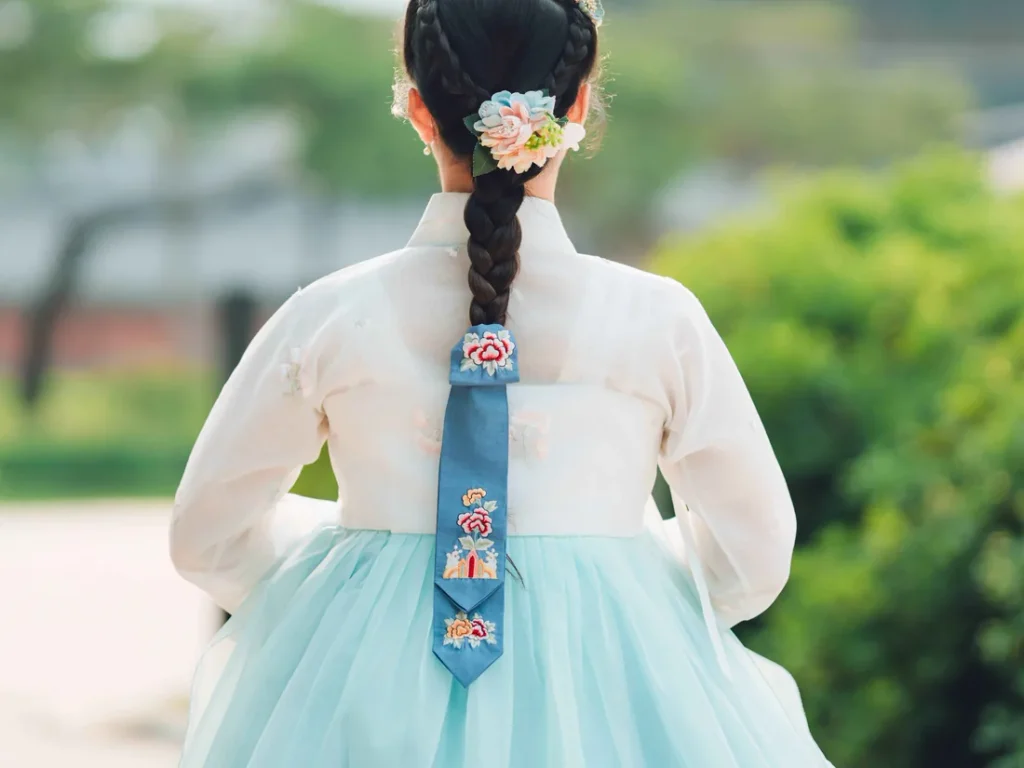
In Joseon Korea, your hair told strangers whether you were married. An unmarried woman wore a single long braid tied with a red ribbon called a daenggi (댕기). A married woman wore her hair pinned into a bun, secured with a long hairpin called a binyeo (비녀). Moreover, the color of the ribbon and the material of the pin communicated your age, your status, and whether you were in mourning — all without a word. Today, the maedeup knot hair tie carries that tradition forward: a hand-tied knot on an everyday elastic, from a craft Koreans have used for over fifteen centuries.
Why This Question Comes Up
If you watch Korean period dramas, you’ve seen the switch happen and probably missed why it mattered.
In one scene, a young woman has a single long braid down her back with a bright red ribbon at the end. Then, a few episodes later — after her wedding — she wears her hair pinned up in a smooth bun, held by a long silver pin. The camera doesn’t explain it. But to a Korean audience, that’s a complete announcement.
Hair in Joseon Korea was more than a style choice. Rather, it was a public statement anyone on the street could read instantly: your age, your class, whether you were available for marriage, whether you were grieving. And the maedeup knot on a hair tie today comes directly out of that world.
The Cultural Context
Why Everyone’s Hair Was Long
Confucian belief held that your body — hair, skin, all of it — was a gift from your parents, and cutting it was a failure of filial duty. So hair simply kept growing, for men and women, for a lifetime.
Which meant that how you tied it became the only vocabulary available. And Koreans built a remarkably precise one.
The Daenggi: A Ribbon That Announced Your Status
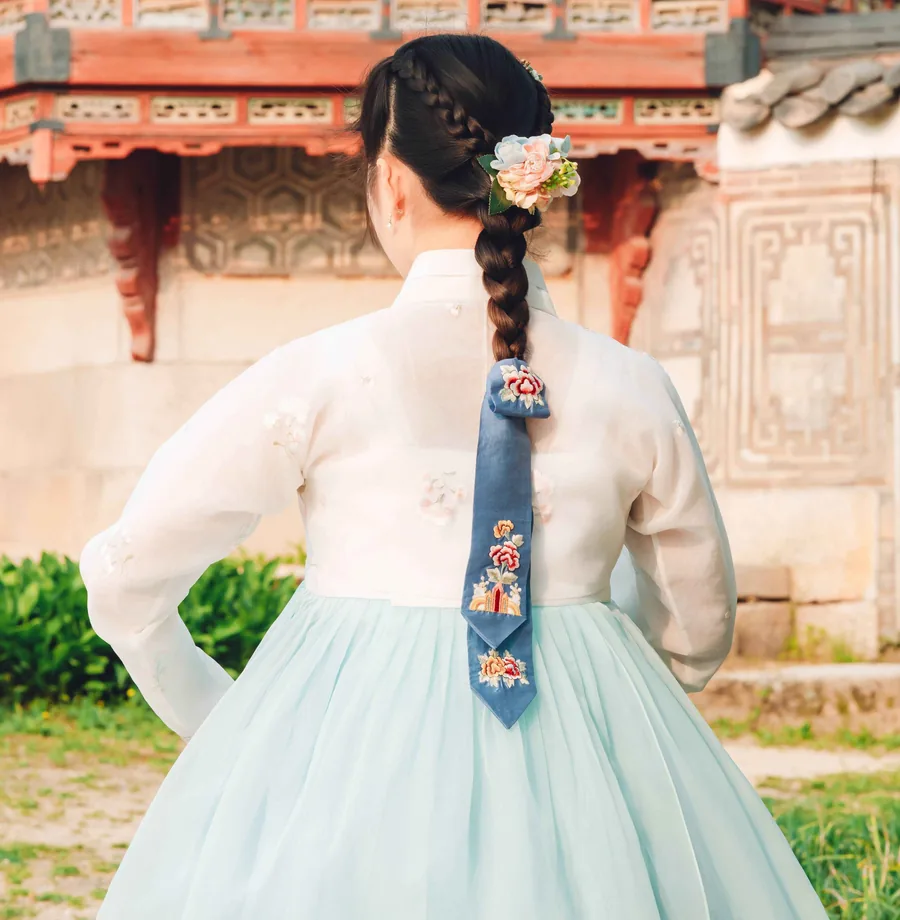
The daenggi is a decorative ribbon tied to the end of a braid. It goes back to the Three Kingdoms era and stayed in use through the entire Joseon period.
Here’s the part that makes period dramas readable: the color was the code.
- Red — commonly worn by unmarried women
- Black — commonly worn by unmarried men
- Purple — often worn by middle-aged women
- Black — often worn by widows
- White — worn during mourning
A single braid with a red ribbon meant I am unmarried. You didn’t have to ask. Children had their own versions, and court ladies wore specific styles depending on their rank and department.
Weddings had their own: the doturak daenggi, a wide silk ribbon roughly 90cm long, hung down the back over the bride’s chignon beneath her ceremonial crown. Printed in gold leaf and set with jade, amber, and coral, it was the single most elaborate hair ornament a Korean woman would ever wear — and most wore it exactly once.
The Binyeo: The Pin That Meant Married
Once a woman married, everything changed. She gathered her hair into a bun at the nape and secured it with a binyeo — a long ornamental pin pushed through it horizontally.
In fact, Korean still carries the trace of this. Both men and women “put their hair up” — meori-reul ollinda — at their coming-of-age ceremony: men twisted theirs into a topknot, women coiled theirs into a bun and pinned it. The phrase still means becoming an adult.
The binyeo carried its own layer of meaning:
- The head of the pin was the wish. Carvings of pomegranates, peaches, plum blossoms, and bamboo signified wealth, long life, and many children.
- The material was the class. Royal women wore gold with dragon or phoenix heads. Noble families used silver, jade, coral. Commoners used wood, horn, or bone. Widows wore plain wood.
- It was a promise. A groom traditionally gave his bride a binyeo as a token of lifelong commitment. Furthermore, if he died first, his family placed the pin in his coffin. A binyeo carved with plum and bamboo — symbols of endurance — was given to women honored for keeping faith after widowhood.
That’s why in dramas, a woman pulling out her binyeo is never a neutral gesture.
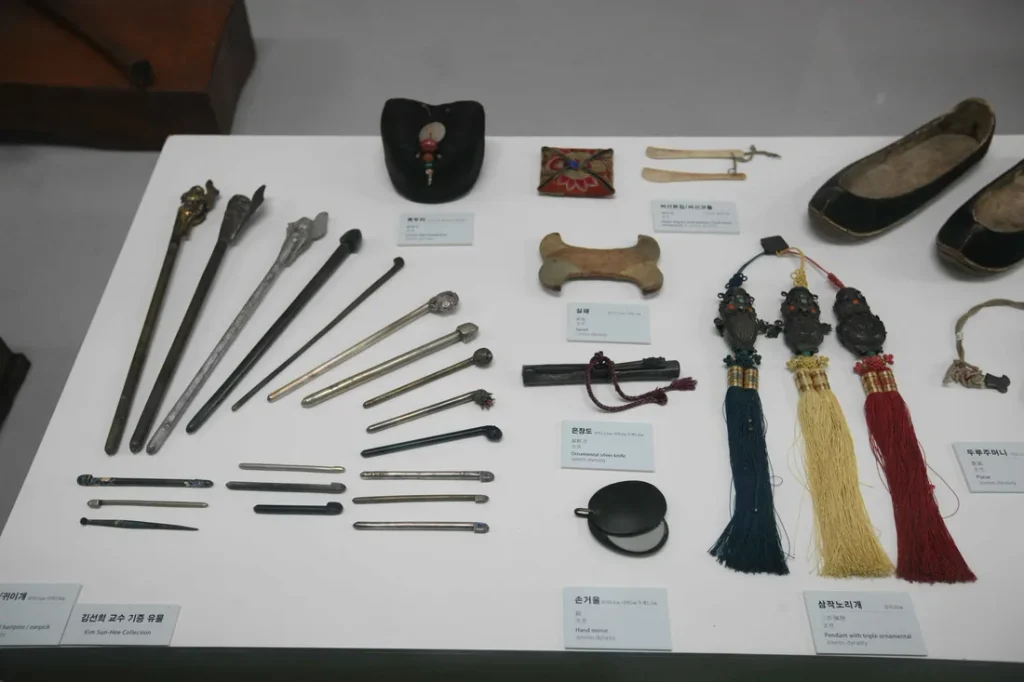
ⓒ Korea Tourism Organization – Park SeonggeunWhere the Maedeup Knot Fits
Maedeup — Korea’s traditional knotting craft — ran through all of it. Decorative knots appeared on the daenggi itself, on ornaments attached to hairpins, and on the ties that held ceremonial hairstyles together. The knot was everywhere in Korean dress, and hair was no exception.
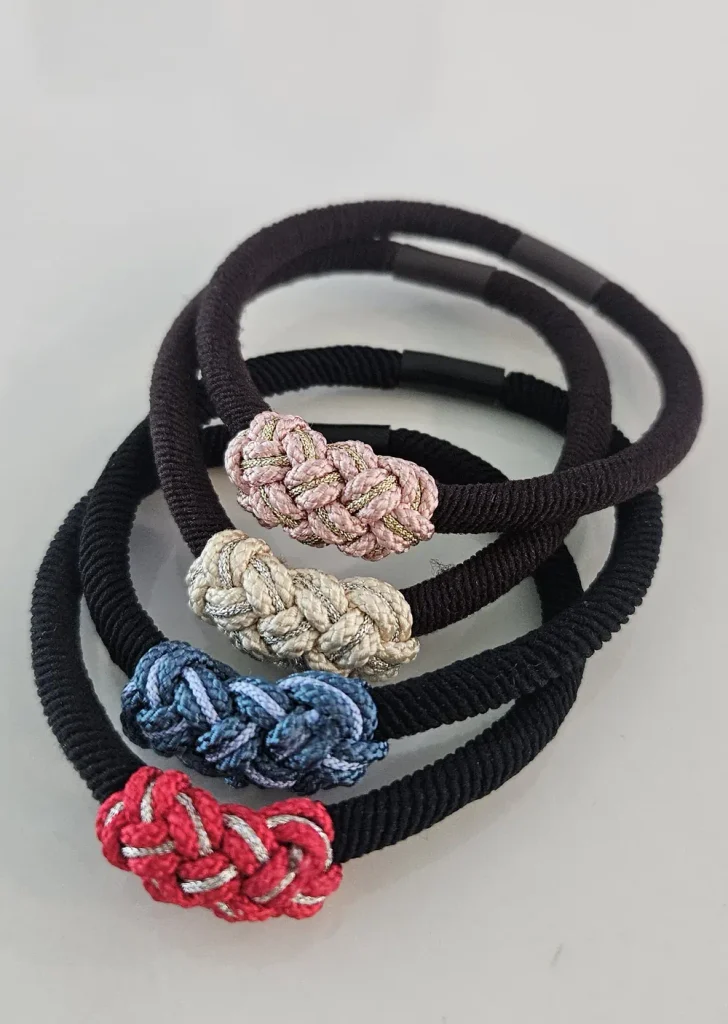
The knot itself hasn’t changed. A chrysanthemum knot tied today is structurally identical to one a Joseon artisan would have tied: the same sequence of loops, the same tension, the same demand for perfect symmetry front to back and left to right.
What Actually Goes Into One
Here’s the whole process, start to finish, in twenty seconds.
Notice what isn’t in that video: a machine. Every loop is placed by hand and pulled tight by hand, and the tension has to be right the first time — a maedeup knot can’t be loosened and re-adjusted without undoing the whole thing.
That’s why a hand-tied knot holds its shape on an elastic that stretches all day. The knot isn’t resting on the band. It’s holding itself.
What’s changed is the format. The Joseon braid and the ceremonial hairpin are no longer part of everyday dress. The elastic replaced the silk ribbon. But the knot survived, and it still does the same job: it says someone made this on purpose.
My Personal Experience
The first time I put a maedeup hair tie on my daughter’s ponytail, I wasn’t thinking about the Joseon Dynasty at all. I was checking whether the size worked, whether it would hold, whether it would slide out by lunchtime.
She wore it all day. It didn’t move.
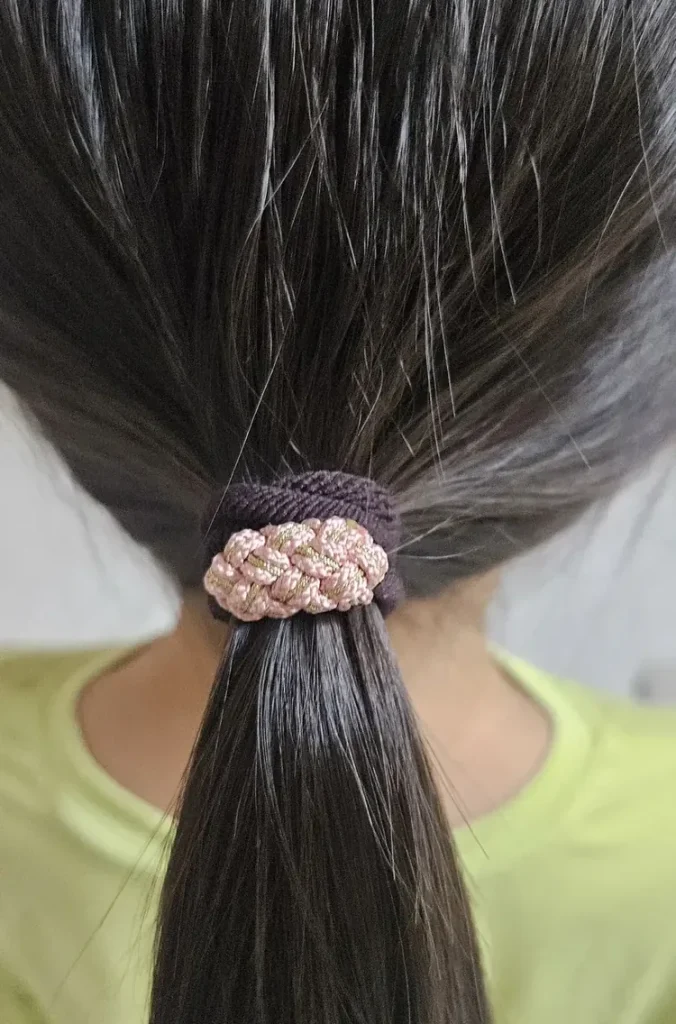
That evening, looking at the small pink knot at the base of her ponytail, I thought about the daenggi. A thousand years ago a Korean mother tied a ribbon into her daughter’s braid — not just to hold the hair, but to say something about her. She is young. Someone is looking after her. These are the wishes we have for her.
The materials are different now. The gesture isn’t. A parent putting something meaningful into a child’s hair turns out to be one of the oldest Korean instincts there is.
Practical Tips
Wearing One
- It works on any style. Ponytails, buns, braids, half-up. Additionally, the knot faces outward, so it reads clearly on any hair type or texture.
- Thick hair, wrap twice. Fine hair, once. As a result, the knot sits on top of the elastic rather than stretching with it, so it stays the same size either way.
- Set it slightly off-center. Traditional Korean hair accessories were rarely placed dead center. Off to one side catches the light better.
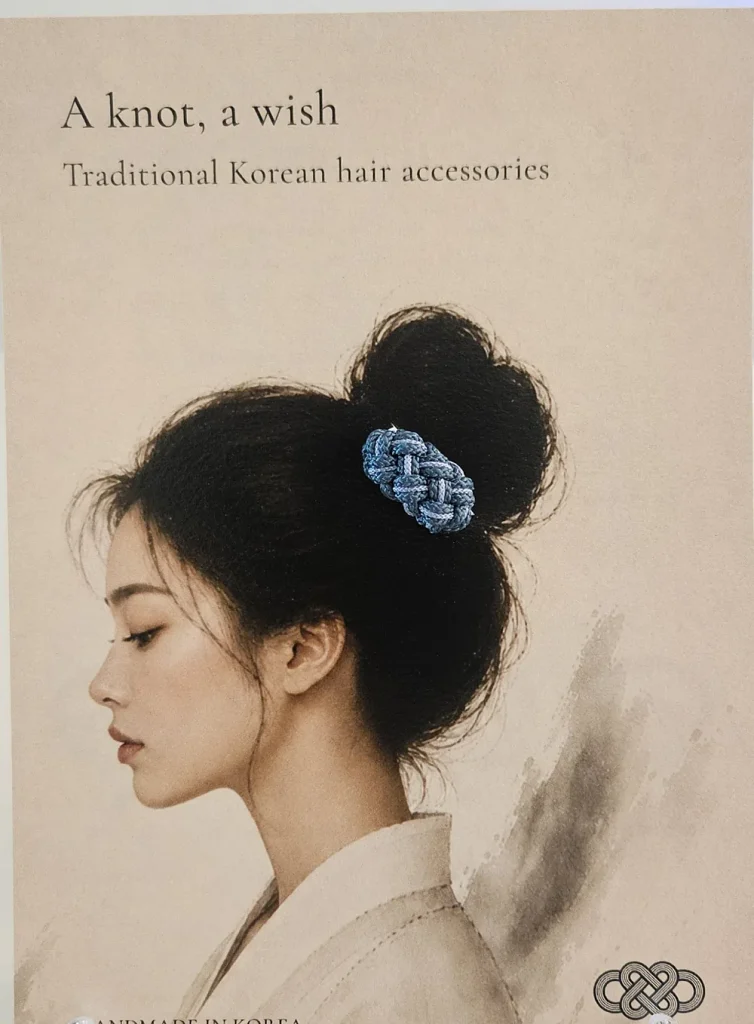
Choosing a Color
- Red — luck, energy, protection. The color of the original daenggi, and the most historically loaded choice.
- Blue — harmony and clarity. The easiest for daily wear.
- Pink — warmth and affection. A common choice when giving one as a gift.
- Cream / gold — quiet elegance. Closest in tone to traditional Joseon silk.
As a Gift
- It fits milestone moments. After all, tying something meaningful into another person’s hair is one of the oldest gestures of care in Korean culture. A first day, a graduation, a move.
- It doubles as a bracelet. Simply wrap it around the wrist when you’re not using it. Many people wear it that way all day.
- It travels well. Light, flat, unbreakable — one of the few Korean souvenirs that survives a suitcase intact.
One More Thing: The Daenggi Is Coming Back
I said earlier that the Joseon braid and the ceremonial hairpin left everyday dress. That part is true. That’s mostly true. But the daenggi is quietly returning, and not as a costume piece.
Korean designers have started making scrunchies with long printed tails — the same silhouette as a daenggi, built onto a modern elastic. My daughters wear them. One is printed with minhwa tigers, the folk-painting tigers that Koreans used for centuries to ward off bad luck. The other is printed with Hangul, the Korean alphabet, in old manuscript style.
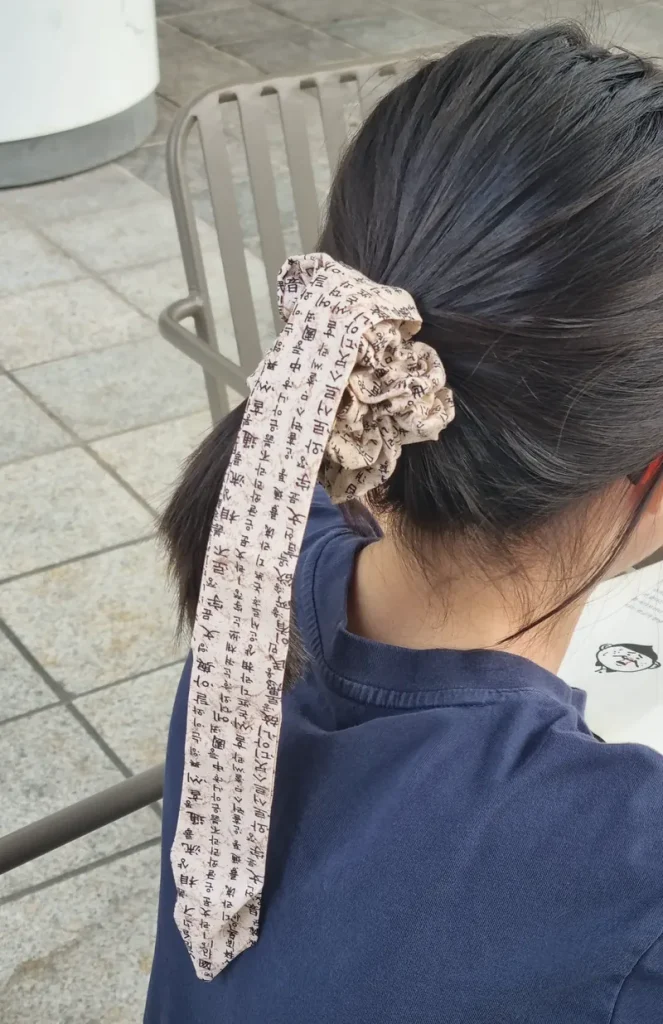
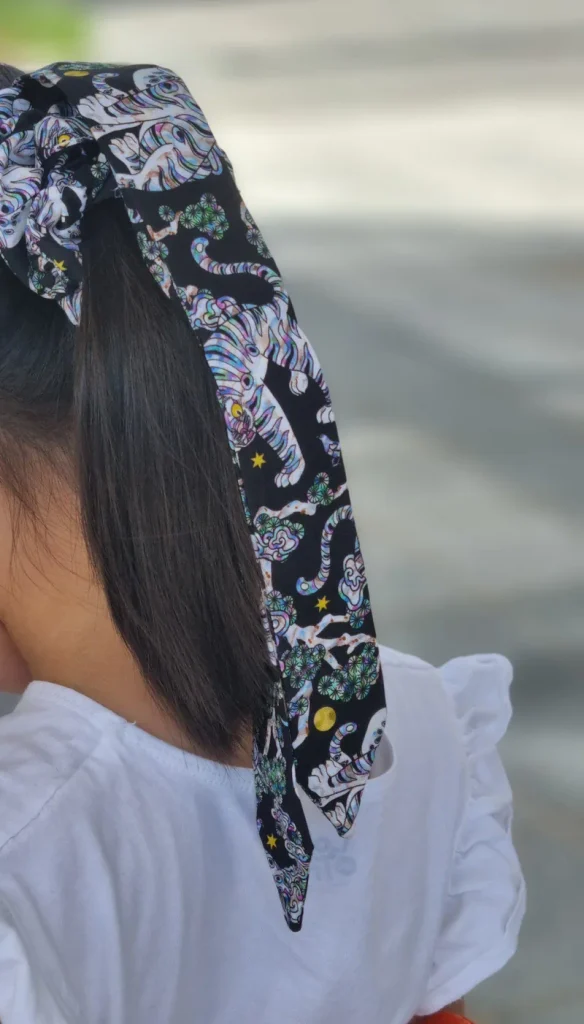
Neither is a reproduction. Instead, both are the daenggi doing what it always did: carrying a picture and a wish down the length of someone’s hair.
That’s the pattern worth noticing in all of this. Korean hair accessories don’t disappear. The format changes — braid to ponytail, silk to elastic, hand-tied bow to maedeup knot — and the thing itself keeps going.
Related Questions You Might Have
- 👉 What Is a Korean Knot Bracelet? History and Meaning of Maedeup
- 👉 What Is a Norigae? The Korean Lucky Charm You’ve Seen in K-Dramas
Want to Try One?
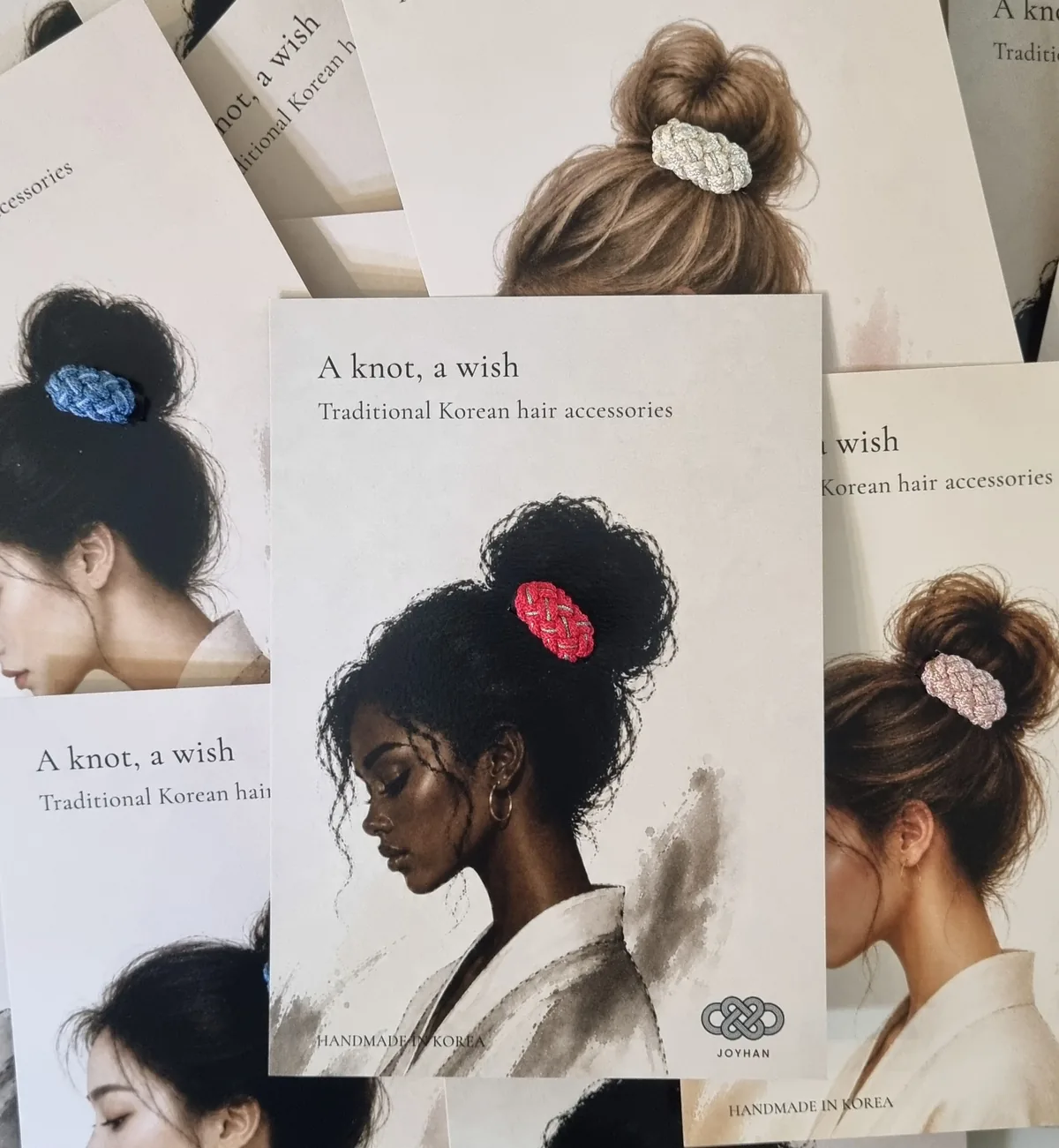
The maedeup knot hair ties from JOY-HAN are handcrafted in Korea using traditional knotting techniques — the same craft that has woven meaning into Korean dress for over fifteen centuries. Each knot is hand-tied, symmetrical on every side, and built to hold.
👉 Shop JOY-HAN Korean Knot Hair Ties on Amazon →
Shared by Oldtree of Mindgrove
Stories of Korea © 2026
Comments
2 responses
Thank you for this. I learned so much and will keep this in mind when I sit to watch a period K drama. Now I want to learn how to do the knots!
Thank you, Kari — that’s exactly what I hoped someone would get from it.
The moment where a character’s hair goes up is easy to miss, but once you
know what it means, you can’t unsee it.
As for tying them yourself: the chrysanthemum knot is the one most people
start with. It looks complicated but it’s a single cord folded in a repeating
pattern. There are Korean maedeup workshops in Seoul that run English
sessions, and a few artisans post step-by-step videos. If I find a good
beginner resource, I’ll write it up.