Why Does Hangul Have 24 Letters When King Sejong Made 28?
Quick Answer (TL;DR) The alphabet promulgated in 1446 had twenty-eight letters. Korean today uses twenty-four. Nobody pruned the other four for being badly designed. Three faded out as the sounds…
Quick Answer (TL;DR)
The alphabet promulgated in 1446 had twenty-eight letters. Korean today uses twenty-four. Nobody pruned the other four for being badly designed. Three faded out as the sounds they stood for disappeared from ordinary speech, over several centuries. The fourth kept its sound and lost its shape, merging into another letter. The last of them left the spelling standard in 1933.
This article is part of my series on Hangul and the Korean language.
Why This Question Comes Up
Anyone who starts learning Korean meets the same number everywhere. Twenty-four letters. Fourteen consonants, ten vowels. Then they walk into a museum, or open a book about King Sejong, and the number is twenty-eight.
Both numbers are correct, which is the confusing part. And the question sharpens once you notice that the extra letters are not theoretical. They are printed in old books, carved on old signs, and still turn up in one corner of the country.
So what happened to them? The usual assumption is that a committee somewhere decided four letters were surplus and struck them off. That is almost exactly backwards.
The Cultural Context
The four are the light hieut (ㆆ), the half-siot (ㅿ), the old ieung (ㆁ), and the araea (ㆍ), a single dot that served as a vowel.
They did not disappear together, or quickly. The light hieut was the first to go, and it barely lived at all — it had a narrow job from the beginning, mostly in writing Sino-Korean, and it was already rare in the fifteenth century. Next went the half-siot, thinning out through the late fifteenth and early sixteenth century. Then the old ieung, fading through the sixteenth and seventeenth. The dot lasted the longest. People were still writing it well into the twentieth century.
Look at what drove each one out and the pattern is the same. A sound shifted in ordinary speech, people stopped needing a letter for it, scribes wrote it less, and eventually it stopped appearing at all. The spoken language moved and dragged the written alphabet along behind it. Nobody was editing the alphabet. They were just talking.
The old ieung is the interesting exception, and it runs the other way. Its sound never left. It is the “ng” at the end of gang, and every Korean says it a hundred times a day. What happened is that the plain ieung (ㅇ), which had a different job, absorbed it, and the two became one shape doing double duty. The sound survived and the letter did not.
The formal end came on October 29, 1933, when the Korean Language Society published a unified spelling standard and dropped the dot. That date did not shrink a living twenty-eight-letter alphabet to twenty-four. It put a formal end to changes that had already been running for centuries. That is the same organisation, under a slightly earlier name, that had created Hangul Day in 1926, and it was doing this work under Japanese colonial rule. So the moment the alphabet shrank to twenty-four was not an act of loss. It was people trying to fix the written language in place while the state around them was trying to replace it.
And the four did not die cleanly. The half-siot left traces in regional dialects, hardened into a siot sound in the words for radish and fox. The dot left its clearest trace on Jeju Island, where the local form of Korean keeps a vowel descended from it, and where people still write it with the dot.
My Personal Experience
I have been typing on Cheonjiin since it existed.
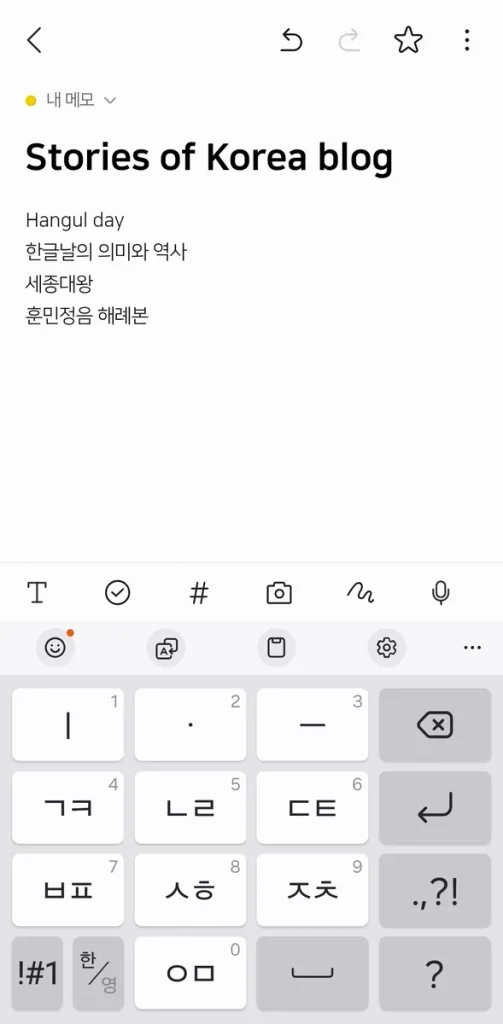
It is the Korean keypad Samsung built in 1994, back in the mobile phone era, and it works by giving you three marks instead of a row of vowels: a vertical line for a standing person, a horizontal line for earth, and a dot for heaven. You build every vowel out of those three. It became the national standard in 2011. Apple added it to the iPhone two years later.
The Cheonjiin keypad on a Samsung phone. The three keys on the top row build every Korean vowel. Photo: Oldtree of Mindgrove
I never switched to QWERTY. I have tried it and I still find the three-key version faster — my thumb knows where the dot is and does not have to hunt across a flat grid of letters. Nothing about that is patriotic. It is just what my hand learned first and never unlearned.
In 2024, Samsung changed the default. Newer Galaxy phones open with a QWERTY keyboard, because younger users said it felt more familiar. Cheonjiin is still there, but you have to go into the settings and choose it, which is what I did, because I was not going to type any other way.
So this is where I have ended up. The dot left the alphabet in 1933. The keypad built around it lost its default slot in 2024. And every morning I pick up my phone and press a letter that is not in the Korean alphabet, several hundred times a day, without once thinking about it.
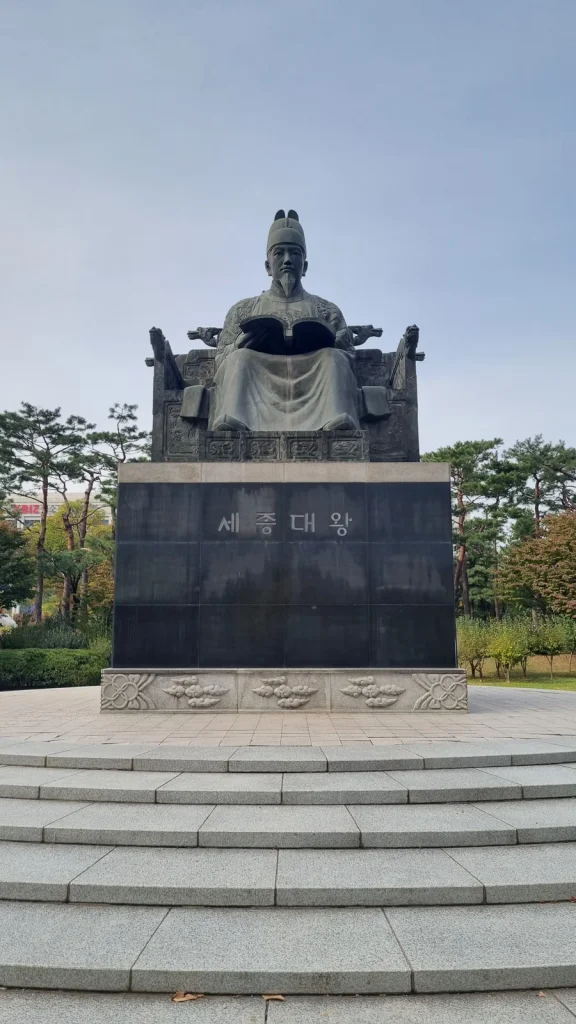
King Sejong Statue, Yeouido Park, Seoul, October. Seoul has more than one. Photo: Oldtree of Mindgrove
Practical Tips
If you are learning Korean, learn twenty-four. You will never have to write the other four. No modern text uses them and no keyboard produces them by default.
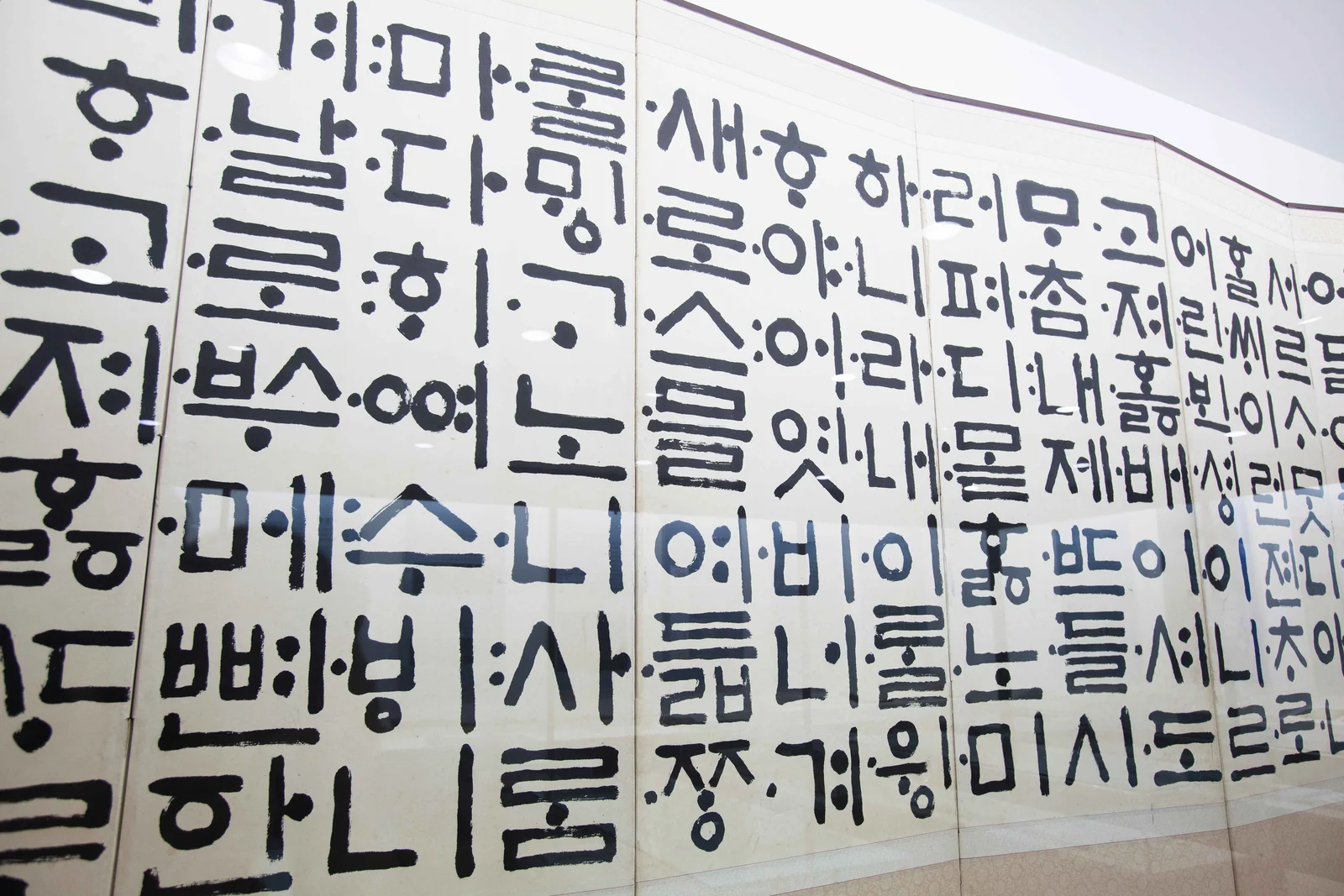
You will still see them. Museum displays, reproduced historical documents, restored shop signage, and calligraphy all use the older letters. The dot beside a syllable in an old text is a tone mark, not a letter, which trips up almost everyone the first time.
Try the dot yourself. Add the Korean keyboard on your phone and choose the 10-key layout rather than the standard one. It is called Cheonjiin, it is on both Samsung and iPhone, and the second key on the top row is the shape of a letter the alphabet no longer has.
Jeju is where the dot left its clearest trace. The island’s own form of Korean keeps a vowel descended from it, and local signage and publications still write it with the dot.
Leave a Reply