What a Year in Korea Actually Feels Like
This article is part of my series on Korean Seasons.
Every guidebook about this country opens with the same line: Korea has four distinct seasons. Most visitors skim past it. Half the world has four seasons — what’s there to explain?
Then they land in Seoul in January, at the same latitude as Athens, and discover that the Han River has frozen over.
Quick Answer (TL;DR)
Yes — and the gap between the four seasons in Korea is much wider than the phrase suggests. Seoul’s coldest month averages −1.9°C and its hottest averages 26.1°C, a swing of roughly 28 degrees across a single year. Spring (April–May) and autumn (September–October) are the two genuinely comfortable windows. Summer is hot and heavily humid, with a monsoon that dumps most of the year’s rain in about eight weeks. Winter is cold, dry, and windy.
If you take one practical thing from this article: pack layers, and do not trust the latitude.
Why This Question Comes Up
The confusion almost always starts with a map.
People look at where Korea sits — 37 degrees north, the same band as southern Spain, Greece, and northern California — and their brain fills in the rest. Mediterranean. Mild. A light jacket in winter, maybe.
I have watched this assumption collide with reality more than once. A visitor arrives in early April expecting cherry blossom weather, packs for spring, and gets caught by a cold snap that drops the morning temperature below freezing. Another arrives in August thinking how bad can thirty degrees be, and finds out within twenty minutes of leaving the airport what thirty degrees does when the humidity is over eighty percent.
The second reason the question comes up is that “four distinct seasons” sounds like tourism copy. It reads like something a tourism board writes when there isn’t much else to say. In Korea’s case it happens to be the plainest possible description of the climate — and if anything, it undersells it.
The Cultural Context
The latitude paradox
Seoul sits at 37.5°N. Athens is at 38.0°N. Seville is at 37.4°N. San Francisco is at 37.8°N — near-identical distances from the equator.
In January, Athens averages a high of 13°C and a low of 6°C. Seville runs roughly 6–16°C. San Francisco sits around 8–15°C. All three are places where January means a scarf and a slightly heavier coat.
Seoul in January averages a high of 2°C and a low of −6°C. Same latitude, roughly ten to twelve degrees colder.
The reason is geography rather than latitude. Korea is a peninsula hanging off the eastern edge of the largest landmass on Earth, facing the largest ocean on Earth. Each winter, the Siberian High — a vast dome of cold, dry continental air — expands and pushes south across the peninsula. Each summer, the North Pacific High pushes the opposite way, dragging hot, saturated maritime air north.
Korea gets both, at close to full strength, every single year. That is why the seasons here don’t blur into one another. They arrive, they take over completely, and they leave.
Spring — March to May
Spring in Korea is short and it is loud.
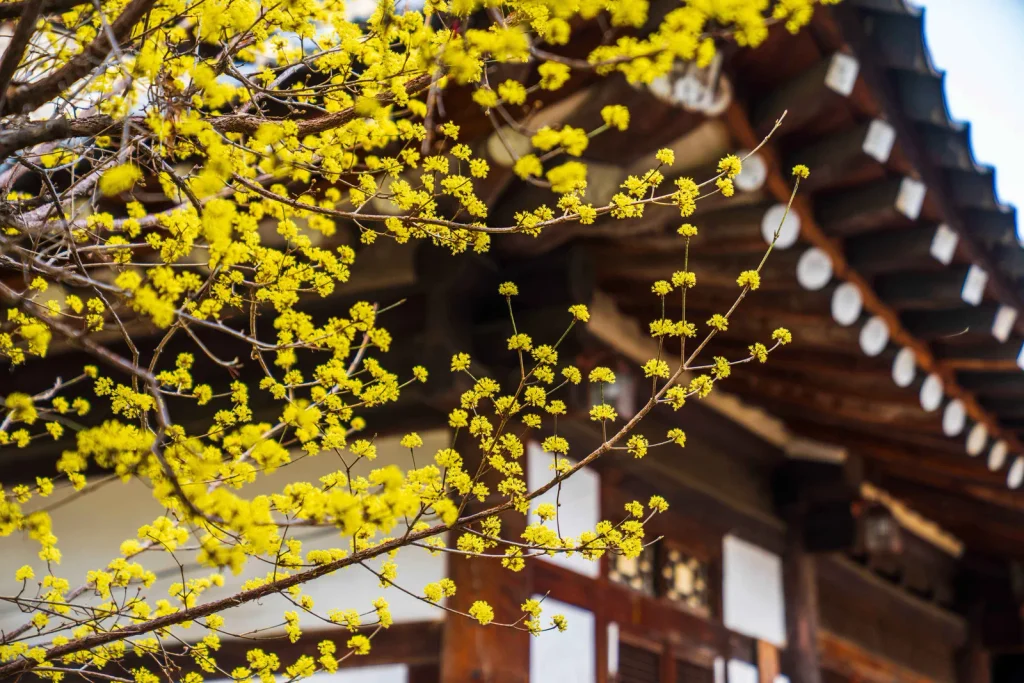
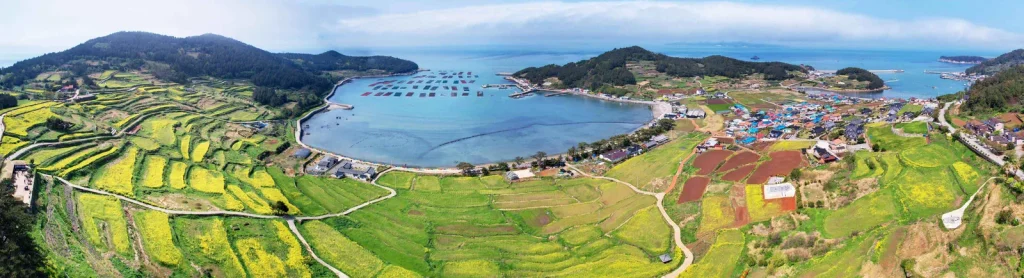
Within a few weeks the whole country goes from bare to blooming. Forsythia first, in bright yellow along roadsides and embankments. Then azaleas. Then the cherry blossoms, moving north up the peninsula like a slow wave over about two weeks. In the countryside, this is when the agricultural year restarts — seedbeds, rice paddies flooded, the whole cycle beginning again.
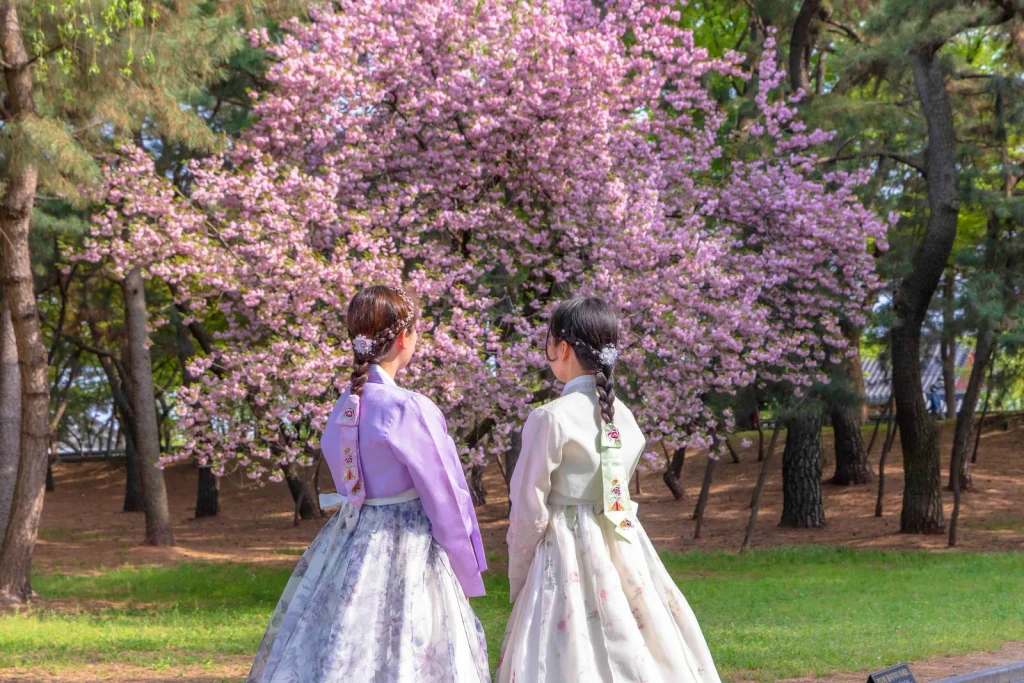
There is a Korean word for how spring makes people feel: chungongjeung (춘곤증), roughly “spring drowsiness.” It describes the specific heaviness that arrives when the body is still calibrated for winter and the air has suddenly gone soft. Offices half-empty of attention. People dozing on the subway at two in the afternoon. It is treated as a real, expected seasonal condition rather than a joke.
Spring also brings the peninsula’s least pleasant seasonal visitor: hwangsa (황사), the yellow dust blown in from the deserts of Mongolia and northern China. On bad days the sky goes flat and beige, and air quality apps turn red.
I want to be fair about this, though, because it has eased. The dust springs of fifteen or twenty years ago were heavier and more frequent than what we get now, and in the last several years I have noticed far fewer of those beige mornings. I don’t know whether that will hold. Spring is still the season where you check the air before you check the forecast — but it is no longer the reason to stay away.
Summer — June to August
Korean summer is not defined by its temperature. It is defined by its water.
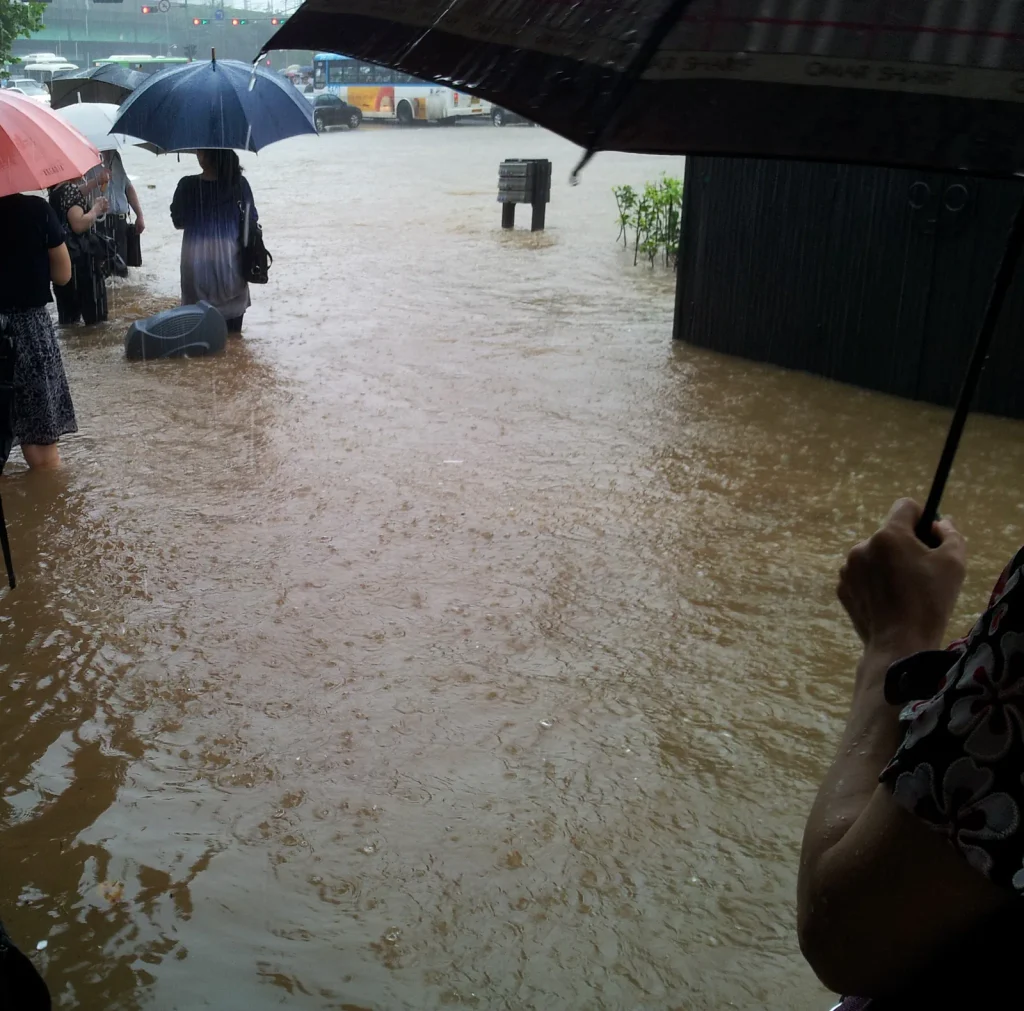
Roughly 63% of Seoul’s annual rainfall arrives in June, July, and August. July alone averages over 400mm. The mechanism is the jangma (장마) — the East Asian monsoon front, which stalls over the peninsula for several weeks and then gets followed by typhoon season.
What that means in practice is a summer where the air feels like a warm towel. Air conditioning is not a comfort item here; it is infrastructure. Laundry does not dry. Shoes do not dry. Umbrellas live permanently in bags.
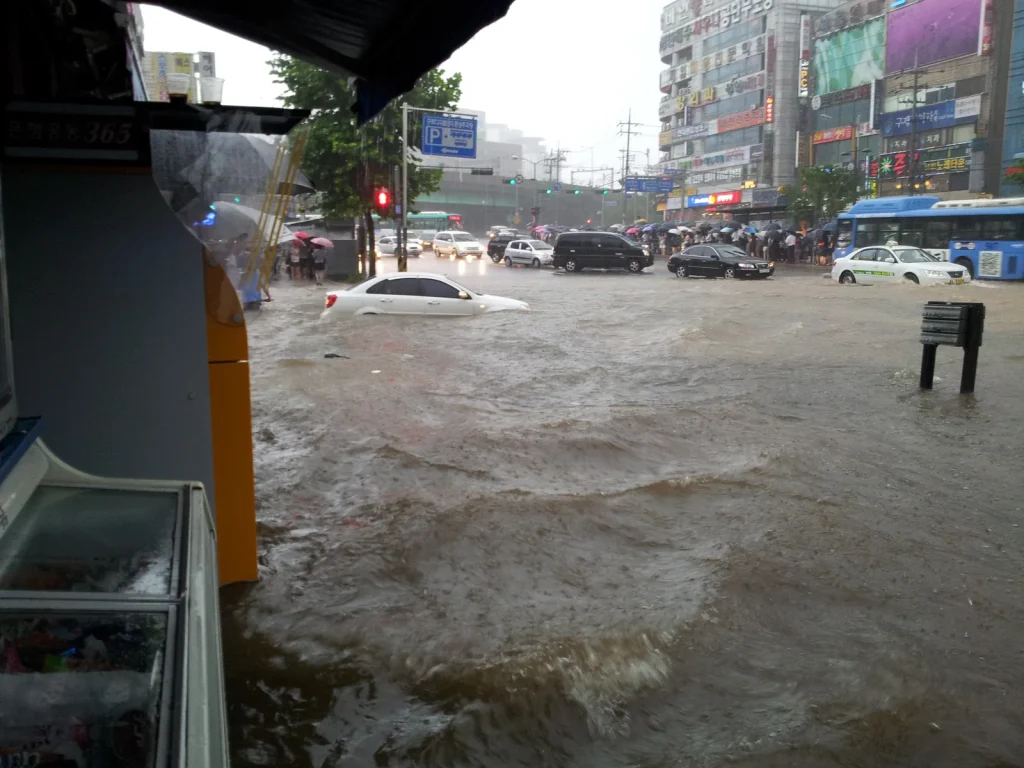
Most summers, that is merely uncomfortable. Some summers it is not.
On the night of 8 August 2022, a rain band stalled over Seoul. In one district of the city, 136.5 millimetres fell in a single hour, breaking a record that had stood since 1942. By the following morning the city had taken 421 millimetres. Roads through Gangnam and Seocho — some of the most expensive ground in the country — became rivers. More than twenty thousand cars across the capital region were flood-damaged in the weeks that followed.
One photograph from that night went everywhere. A man sat on the roof of his submerged sedan, water at the door handles, phone in hand, waiting. The internet named him the Sage of Seocho-dong. (Chosun Ilbo, 8 August 2022)
The nickname was affectionate, but it turned out to be literal. Disaster-safety specialists reviewing that night agreed he had made the correct call: the water had stopped rising, and staying on the roof was safer than wading into a current he could not see. So he sat there and waited to be reached.
Three people died in Seoul that night, so this is not a funny story. But it is a revealing one. A country that takes on this much water this fast, this regularly, produces people who know without being told that the right move is sometimes to stop, sit down on the roof, and wait it out.
And this is the season when Korean food culture does something that baffles almost every visitor: on the hottest days of the year, people queue up for boiling chicken soup. There is a principle behind it — iyeol-chiyeol (이열치열), meeting heat with heat — and it deserves its own article, which is coming.
Autumn — September to November
This is my favourite season, and I don’t think I’m unusual in that.
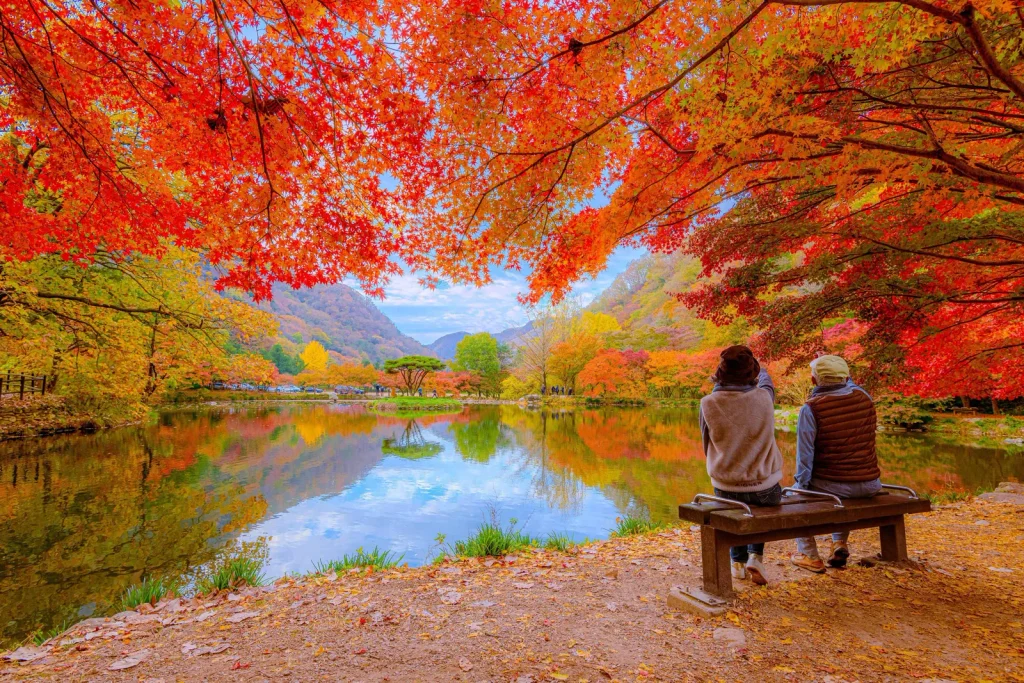
Sometime in mid-September the humidity breaks. It happens quickly, often over a single night. The air goes dry and clean, the sky lifts into a blue that photographs badly because nobody believes it, and the temperature settles into the high teens and low twenties. Then the mountains turn — reds and oranges rolling south down the peninsula through October and into November.
Koreans describe this season with a four-character phrase: cheon-go-ma-bi (천고마비), “the sky is high and the horses grow fat.” Today it is used purely as praise — the season of clear skies and abundance.
Its origin was the opposite. The phrase descends from a classical Chinese expression about frontier horses fattening on autumn grass, associated with the season when northern nomadic riders came south to raid the settled farmlands before winter. Fat horses meant fast horses. The saying was a warning. Somewhere along the way it flipped completely and became a compliment to the weather.
(Note: classical sources differ on the exact origin — some trace it to the Han-dynasty histories, others to a Tang-dynasty poem. The meaning-reversal is well attested; the specific attribution is not settled.)
Winter — December to February
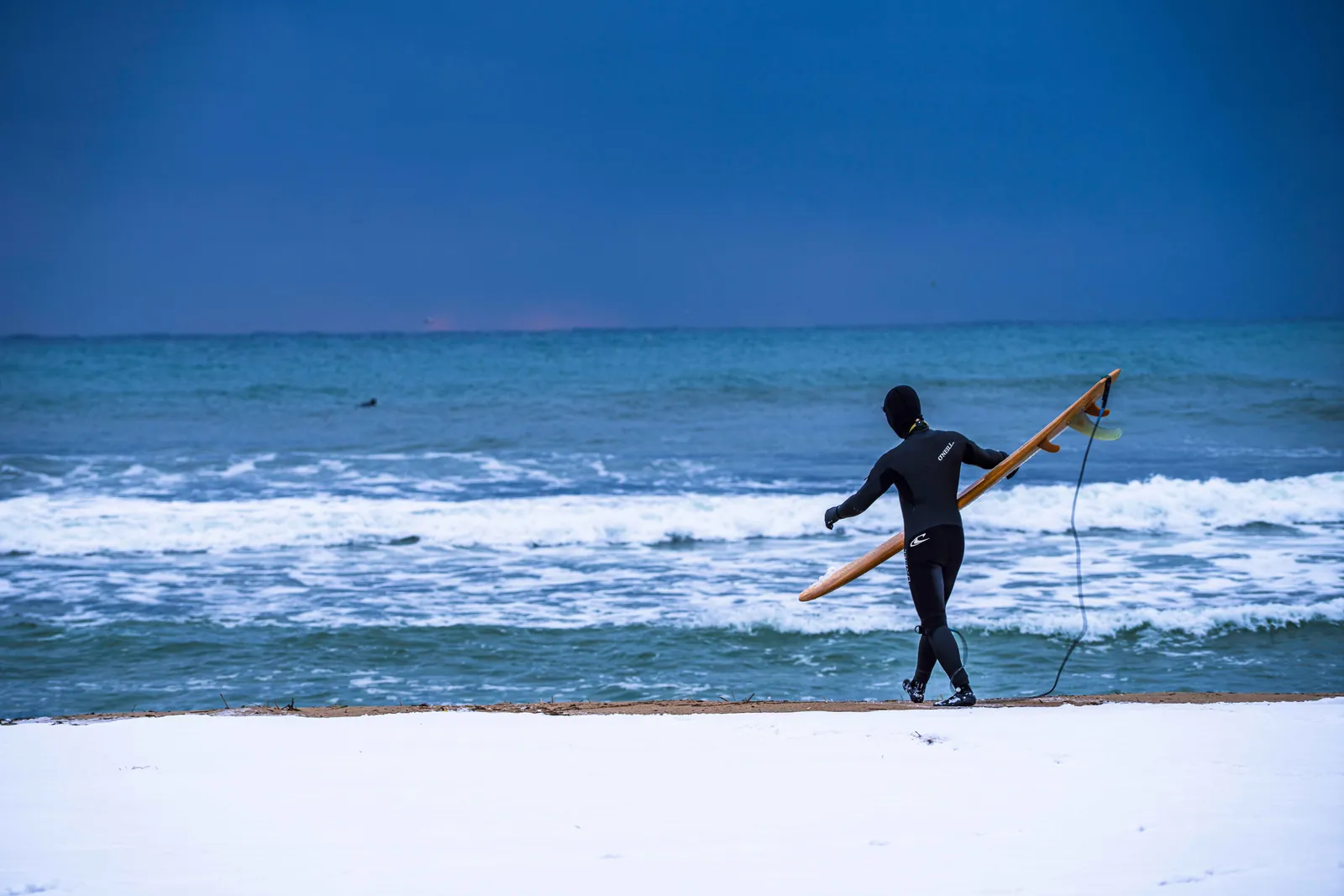
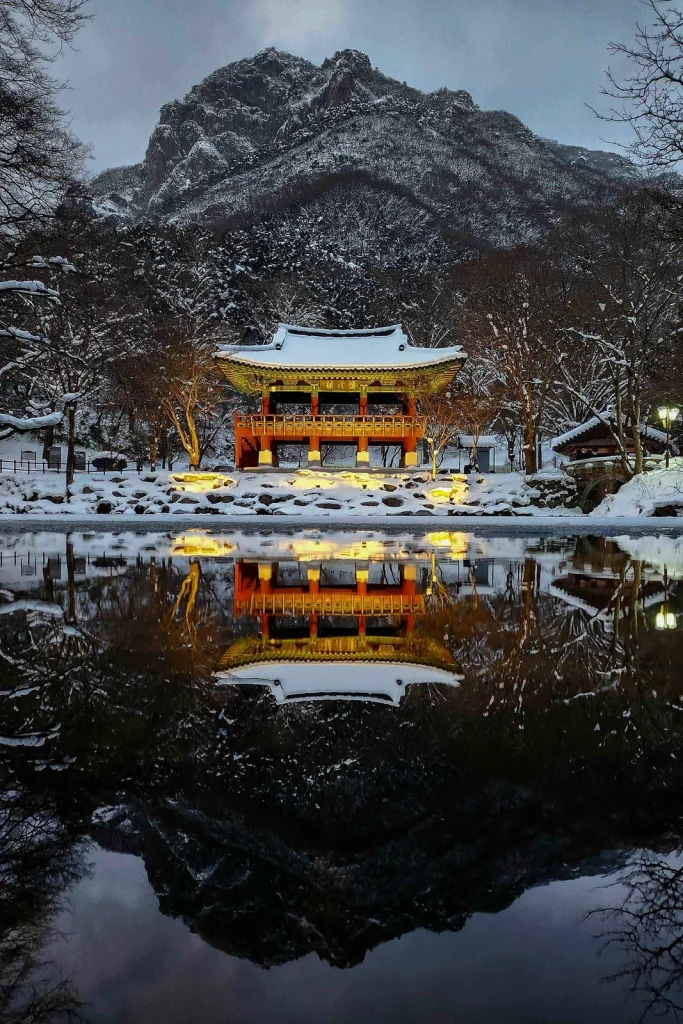
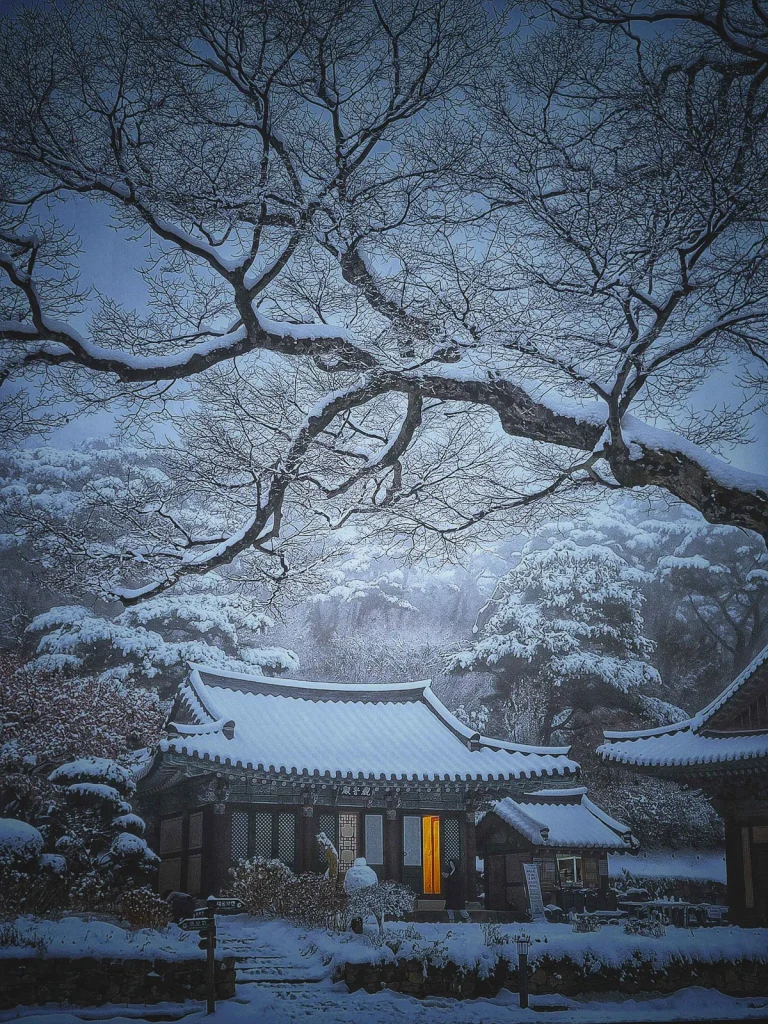
Winter is cold, and — this is the part people don’t expect — it is dry. Only about 5% of Seoul’s annual precipitation falls in December, January, and February. So the cold is not a damp, grey European cold. It is a bright, sharp, wind-driven cold under a hard blue sky.
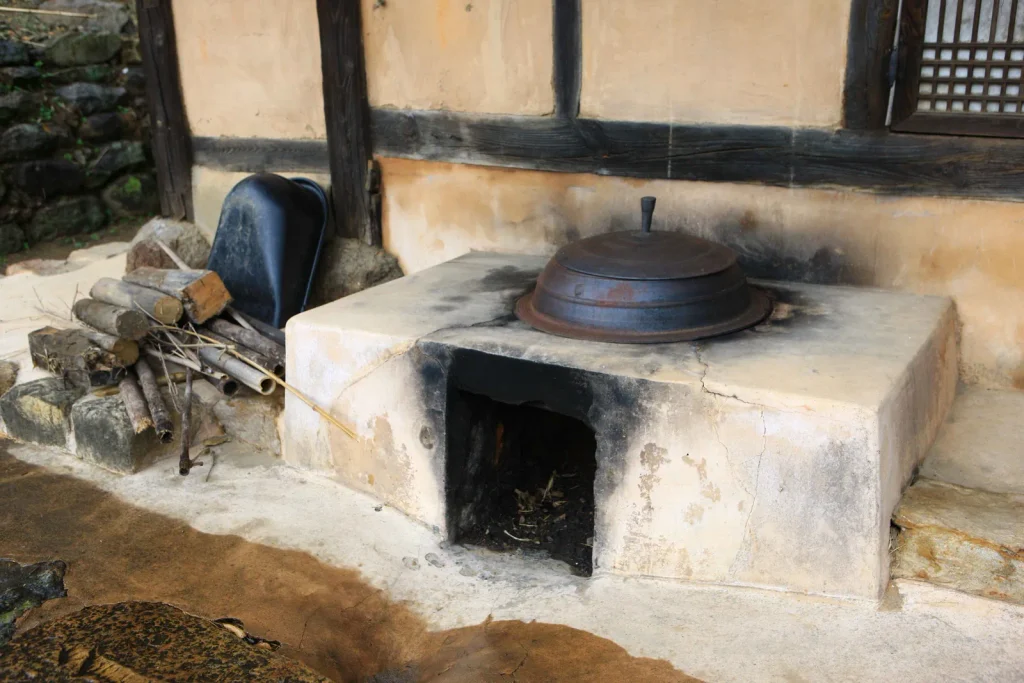
Korean winters also used to be longer than they are now, and the architecture reflects it. Korea developed ondol (온돌), an underfloor heating system built around a firebox called an agungi, set into the kitchen floor at the edge of the house. A cast-iron pot sat over the opening; the smoke and heat went the other way, drawn through flues running beneath the stone floor of the room next door before leaving by a chimney at the far end.
The point is that one fire did two jobs. The same burning wood that cooked the family’s rice heated the room they slept in. In a country where winter was long and firewood was not free, that is not a quaint detail — it is the whole design.
It is also the reason Korean domestic life happens at floor level: sitting, eating, and sleeping on the warm floor rather than raised up on furniture. Modern Korean apartments still heat the floor first, using hot water pipes instead of smoke. A thousand-year-old answer to the Siberian High is still the default setting in a 2026 high-rise.
What the extremes built
This is the part I find genuinely interesting, and it’s why I wanted to write this article rather than another packing list.
A climate with this much annual range does not just decide what you wear. Over a long enough period it decides how you build, what you eat, and when you do things.
- Ondol exists because winter was long and fuel was scarce.
- Kimjang (김장) — the communal making of a winter’s worth of kimchi in late November — exists because for most of Korean history there were four months with nothing growing.
- Iyeol-chiyeol exists because summer took something out of people that had to be put back.
- Even the wardrobe habit is structural. Koreans keep genuinely separate seasonal clothing, stored and rotated, because a single coat cannot cover a 28-degree annual range.
None of that is unique to Korea in isolation. Plenty of countries get colder, and plenty get hotter. What is unusual is getting both, sharply, in the same twelve months, in the same place, every year. My own view — and it is a view, not a fact — is that living inside that cycle does something to a people over time. It builds an assumption that conditions will change, that the current state is temporary, and that you had better prepare for the next one while this one is still comfortable.
My Personal Experience
There are two summers I have never been able to put down.
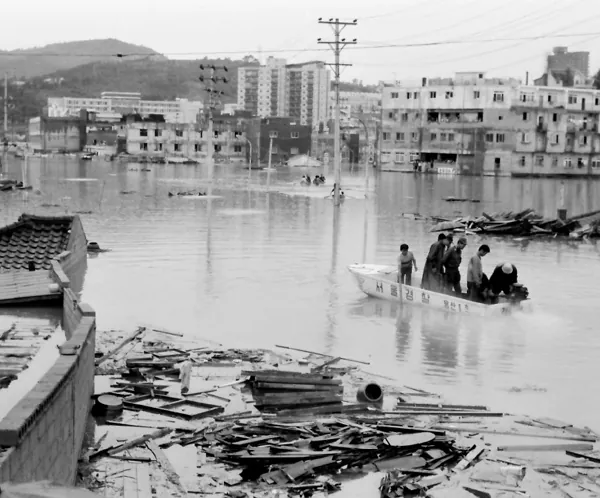
I barely have the first one. It was 1979. I was five, by Korean reckoning, and we lived beside the Anyangcheon, a stream that feeds into the Han River. It was not a famous flood. In those years the small ones came often enough that they did not need names. The water came up. My two older brothers went out on the back of a neighbour — some man from down the road, I never knew which one. My mother carried me on hers. Everyone in the area ended up in the same place: a bathhouse on the second floor of a building, the highest thing we had. My father came straight there from work.
The water reached an adult’s waist. That is not what I remember, though. What I remember is a sound.
In our yard, buried in the ground, was the kimchi jar. Refrigerators were not yet a normal thing to own in an ordinary Korean house in 1979, so the winter’s kimchi went into an earthenware jar and the jar went into the earth, where the ground held it at a steady cold for the whole season. Every household did this. (Koreans still make their kimchi in November. It goes into a dedicated kimchi refrigerator now — which is a story for its own article.)
The floodwater got underneath that jar and it came out of the ground with a bang. I remember it coming up. I remember brown water turning around on itself in the yard. Then nothing else.
I have thought about that jar for a long time. Winter had been prepared for, carefully, months in advance. Summer took it back in a night.
The second summer is 1994, and I remember all of it, because nothing happened in it. School holidays, and it was too hot to do anything at all. We had one electric fan in the house and no air conditioner, which in Korea in 1994 was simply normal. I lay on the floor in shorts and read, and showered three or four times a day, and that was the entire summer.
1994 is remembered here as the heat that sent Korean households out to buy air conditioners. I was lying on that floor at the end of something, and I had no idea.
The other thing I have noticed is how this climate looks from the outside. There has been an American military presence here for over seventy years, and among the people I’ve spoken to, a joke circulates: Korea is an outstanding place to train, because the peninsula will hand you every condition you could possibly need to prepare for. Deep cold in January. Punishing heat and humidity in August. And in between, a monsoon that lets you practise operating soaked through for weeks at a time. I have no idea whether any official ever said this. But I have heard it more than once, and having lived here my whole life, I understand exactly why someone would.
Practical Tips
When to come. April to May, or September to October. This is the standard advice and it is standard because it is correct. Late April gives you comfortable temperatures after the blossom crowds have thinned. October gives you the clearest skies of the year and the autumn foliage.
Pack for two temperatures, not one. Even in the good months, the gap between a Korean morning and a Korean afternoon can be ten degrees. Layers are not optional. A packable outer layer you can take off at 11am and put back on at 6pm will do more for your trip than any single perfect jacket.
If you come in summer: bring genuinely breathable fabric, not just light fabric. Assume rain on any given day between late June and early August. Plan indoor anchors — museums, cafés, department stores — into each day rather than treating them as backups.
If you come in winter: the cold is dry and wind-driven, so wind-blocking matters more than bulk. Cover your ears and hands. Indoors you will often be too warm, because the floor is heated, so wear something you can strip down to.
If you come in spring: check an air quality app in the morning the way you’d check rain. On a high-dust day, a mask is normal here and nobody will look at you twice.
Related Questions You Might Have
- Why do Koreans eat boiling hot soup on the hottest day of summer? — the logic of iyeol-chiyeol, and what boknal actually is. (coming soon)
- Why do Koreans make a whole year’s kimchi in one weekend? — kimjang, and what happens when nothing grows for four months. (coming soon)
- What is dongji? — the winter solstice, red bean porridge, and why it was once treated as a small new year. (coming soon)
- Why Do Koreans Eat Samgyeopsal with Soju?
- What Are Doenjang, Ganjang & Gochujang? Korean Sauces Guide
I write about Korean culture, food, and history from the inside — the things that are obvious to Koreans and invisible to everyone else.
Shared by Oldtree of Mindgrove
Stories of Korea © 2026


Leave a Reply