Why Is Makgeolli Cloudy? The Story Inside Korea’s Milky Rice Wine
This article is part of my series on Korean traditional alcohol. Quick Answer (TL;DR) Makgeolli is cloudy because it is only roughly filtered. The haze comes from tiny particles of…
This article is part of my series on Korean traditional alcohol.
Quick Answer (TL;DR)
Makgeolli is cloudy because it is only roughly filtered. The haze comes from tiny particles of fermented rice, live yeast, and nuruk — Korea’s traditional fermentation starter — that stay suspended in the liquid. In fact, the name itself explains it: mak means “roughly, just now,” and georeuda means “to filter.” Makgeolli is literally “the roughly filtered one,” and that roughness is the whole point.
Why This Question Comes Up
Most rice wines that foreigners know look clear. Japanese sake is polished and transparent. Chinese baijiu looks like vodka. So when a bottle of makgeolli arrives at the table — milky, fizzy, with a white layer sleeping at the bottom — many visitors hesitate. Is it spoiled? Is it supposed to look like watered-down yogurt?
I have watched this moment many times. A foreign friend lifts the bottle, squints at the sediment, and asks quietly, “Is this… okay to drink?” It is more than okay. That cloudiness is not a flaw. It carries both a class history that goes back centuries and a colony of microorganisms that are still alive.
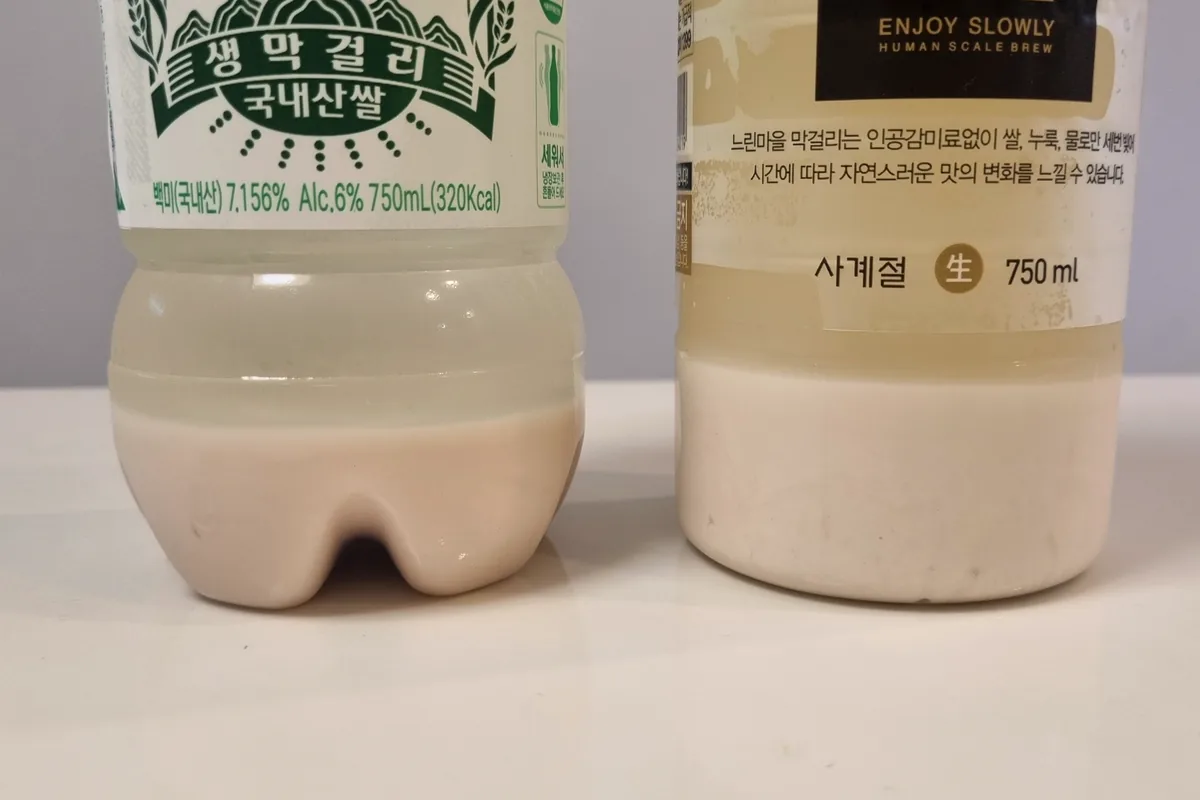
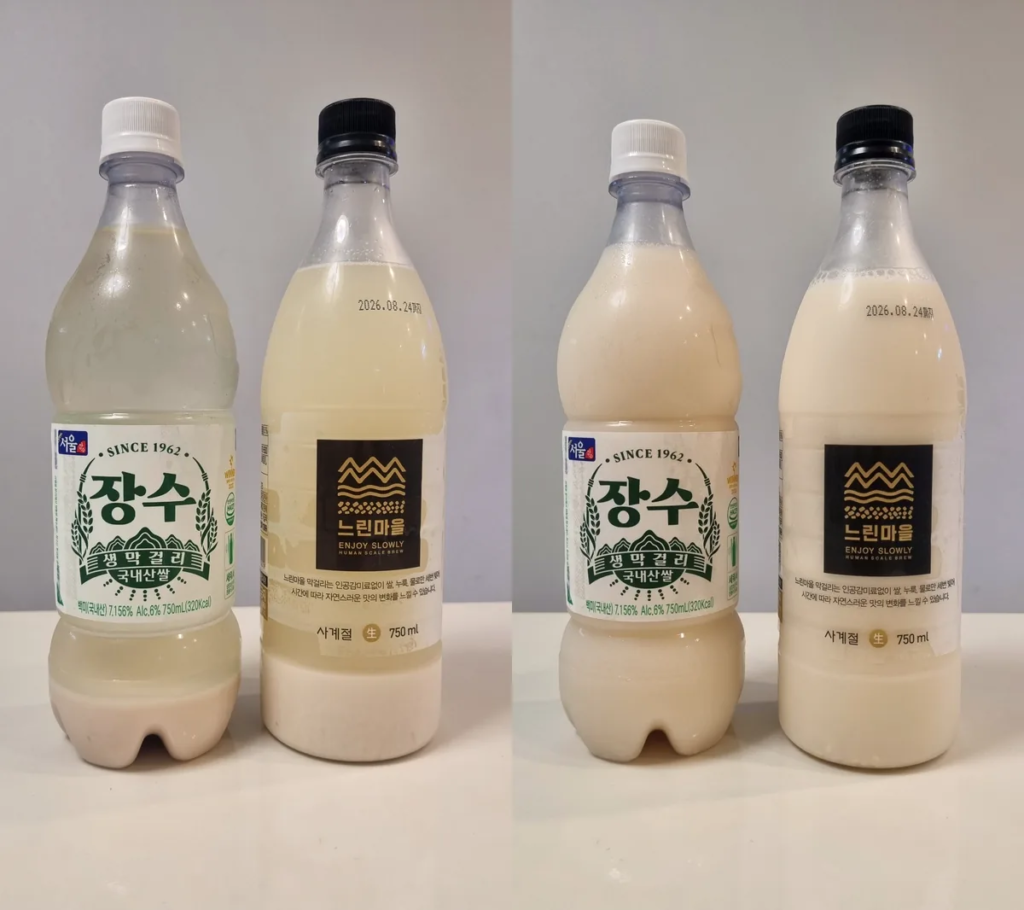
The same two bottles, thirty seconds apart. Nothing was added.
The Cultural Context
One Brew, Two Destinies
The base recipe is simple: steamed rice, water, and nuruk, a fermentation cake carrying wild yeasts and molds. After fermentation, the brewer faces a choice.
If you let the mixture settle and carefully draw off only the clear liquid floating on top, you get cheongju (청주), “clear wine.” This refined drink was expensive, labor-intensive, and historically reserved for the nobility and for ancestral rites.
But what about the thick, milky layer of rice solids left at the bottom? Ordinary people did not waste it. They pressed it through a coarse sieve, added water, and drank it. This was takju (탁주), “cloudy wine,” and makgeolli is its most famous form. One brew, two destinies: the clear top for the aristocrats, the cloudy remainder for everyone else.
The Farmer’s Drink
That is why makgeolli earned another nickname: nongju (농주), “farmer’s wine.” At six to nine percent alcohol, it was mild but thick with rice particles, proteins, and live yeast. For a farmer working a long day in the fields, it was closer to a meal than a drink — calories, hydration, and a gentle buzz in one bowl.
The cloudiness, then, was never an accident. It was economics. Clear wine took time, skill, and surplus rice. Cloudy wine took whatever remained and turned it into nourishment. When you see that white haze, you are looking at the drink of people who could not afford to throw anything away.
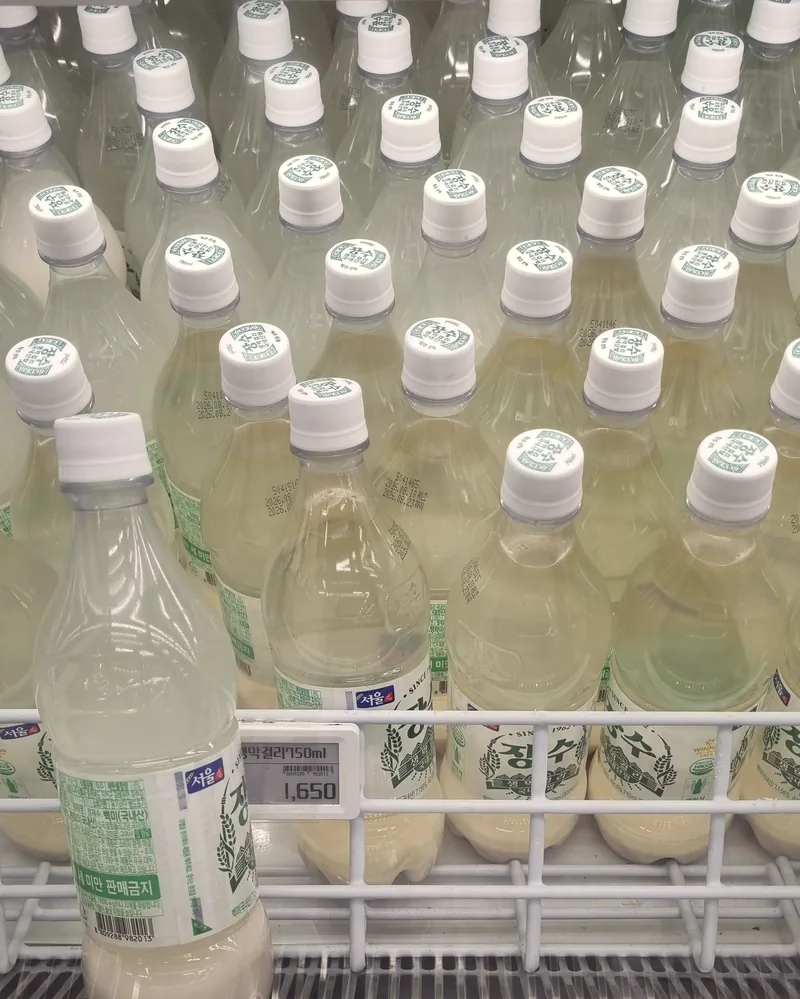
Some of that is still true today. A 750 ml bottle of standard makgeolli sells for around 1,650 won in a Korean supermarket — less than a cup of coffee, and cheaper than almost anything else on the shelf.
Every bottle on the shelf looks like this. Separation is the normal resting state, not a sign that something has gone wrong.
Proof That the Cloudiness Is Alive
Here is the clearest evidence that the haze is not inert debris. Unpasteurized saeng makgeolli keeps fermenting after bottling, so the same product tastes different depending on how many days have passed since it was brewed.
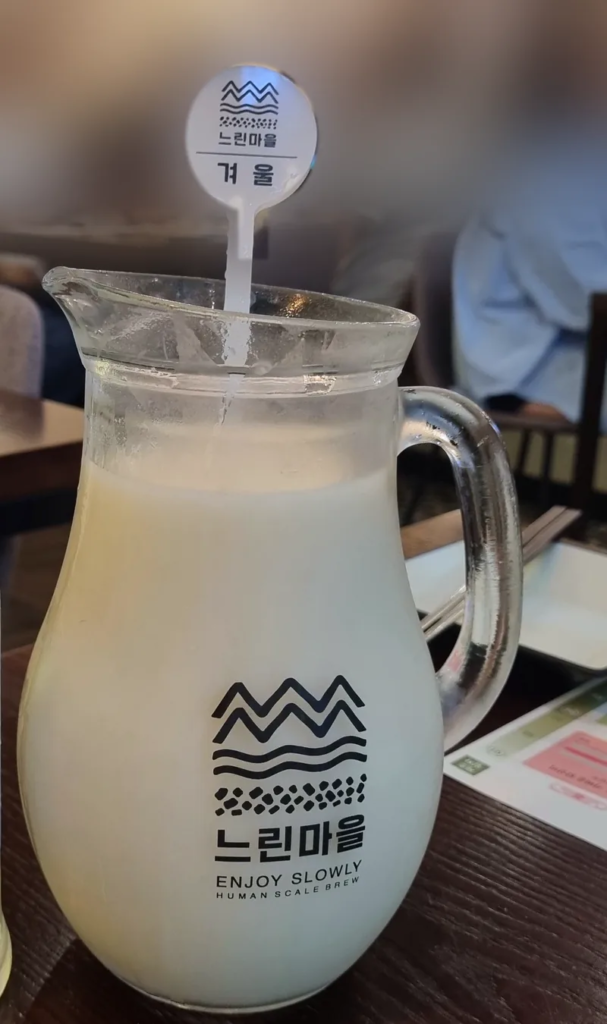
One Korean brewery built an entire product line around this. Baesangmyun Brewery sells its Neurin Maeul (느린마을, “Slow Village”) makgeolli by season — spring, summer, autumn, winter — where the season refers not to the calendar but to how far fermentation has progressed. Spring is youngest and sweetest. As the yeast keeps working, sweetness drops and carbonation sharpens, until winter arrives dry and faintly bitter. Since 2023 the bottles carry a QR code so you can check the brewing date before you buy.
Nothing about the recipe changes between those bottles. Only time does. The cloud in your glass is a working colony, which is also why the label insists on refrigeration.
The marker reads “winter” — not the season, but how far this batch has fermented.
When the Rice Disappeared
There is one more chapter. Through the 1960s, a series of grain-conservation orders progressively pushed rice out of Korean brewing, and makgeolli makers turned to imported wheat flour instead. The drink survived, but its character changed — a story I tell in full in my article on why Korean traditional alcohol nearly disappeared. Rice makgeolli did not return to the market until December 1977, fourteen years later. Today’s cloudy bottle is, quietly, a restoration project.
My Personal Experience
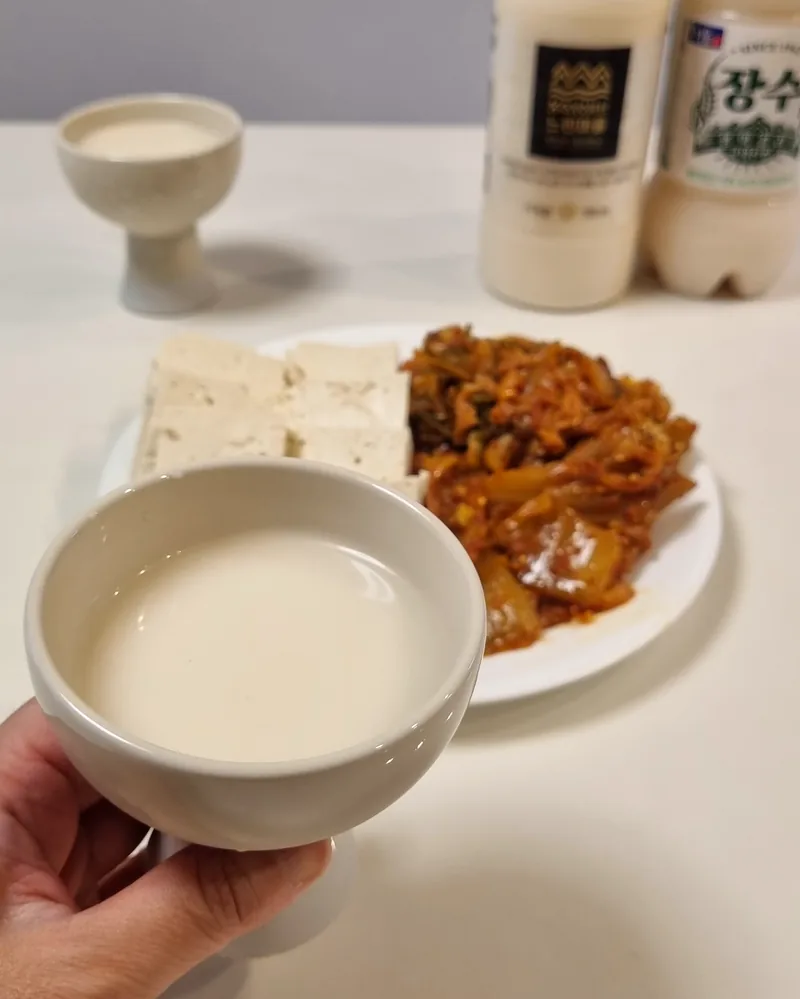
Makgeolli, for me, is a slow-table drink. It rarely appears alone. Someone sets out a plate of warm tofu and stir-fried kimchi, someone else fetches two shallow bowls, and the bottle gets turned over a few times before anyone pours.
The pour itself is worth watching. The liquid comes out the color of morning fog, and for a second you can see the sediment folding into the clear layer above it before the whole bowl turns opaque. It tastes lightly sour, faintly sweet, a little fizzy on the tongue — like a drink that has not fully decided whether to be alcohol or food.
What strikes me is how unhurried it all feels. Soju gets poured in quick shots and swallowed fast. Makgeolli gets ladled into bowls and sipped between bites, and the bowl is wide enough that you have to slow down to avoid spilling it. It is the least glamorous alcohol in Korea, and somehow the most comforting.
Makgeolli is traditionally drunk from a wide bowl, not a glass.
Practical Tips
Mix it gently before pouring. The sediment settles fast. Do not shake the bottle hard like a cocktail shaker — unpasteurized makgeolli is naturally carbonated, and a violent shake can send it foaming over the moment you open it. Close the cap, turn the bottle slowly upside down two or three times, then let it rest before opening.
Or skip the mixing on purpose. Some Koreans pour only the clear upper layer for a lighter, crisper taste. There is no single correct method. Try both and decide which side of the takju–cheongju divide you belong to.
Drink it cold, from a bowl if you can. Makgeolli is traditionally served chilled in shallow bowls rather than glasses. The wide rim carries the yeasty, faintly fruity aroma to you.
Pair it with something savory. Dubu kimchi — warm boiled tofu with stir-fried kimchi — is the everyday partner most Koreans reach for. Pajeon, a green onion pancake, is the other classic, especially on a rainy day.
Check the label for “saeng” (생). It means raw, or unpasteurized — livelier, fizzier, and closer to what farmers drank, but it must stay refrigerated and does not keep long. Pasteurized export bottles are more stable and considerably tamer.
Makgeolli is a category, not a single product. Most Korean stores stock dozens.