
Get Ready to Laugh
In Parts 1 and 2, we explored the cultural depth behind Derpy from K-pop Demon Hunters. We learned about Hojakdo paintings, discovered that Korea itself takes the shape of this majestic creature, and saw how these animals remain powerful symbols in modern life.
Now it’s time for the fun part – Korean tiger folktales that have made Koreans laugh for centuries! From the hilarious dried persimmon story to touching tales of gratitude, these Korean tiger folktales reveal our unique sense of humor and deep cultural values.

Our folklore overflows with tales showing our unique sense of humor. These aren’t scary monster narratives meant to frighten children. Instead, they’re clever, funny accounts that often make the mighty predator look foolish while teaching important lessons about life.
Today, I’m sharing the complete version of Korea’s most beloved tale: the dried persimmon. I’ll also tell you about grateful animals who showed more honor than humans, proving that even fearsome predators understood kindness and loyalty.
Tiger and Dried Persimmon: A Classic Korean Folktale
Remember in Part 1 when I mentioned one who became terrified of dried persimmons? Here’s the full account that children have been giggling about for generations:
The Setup
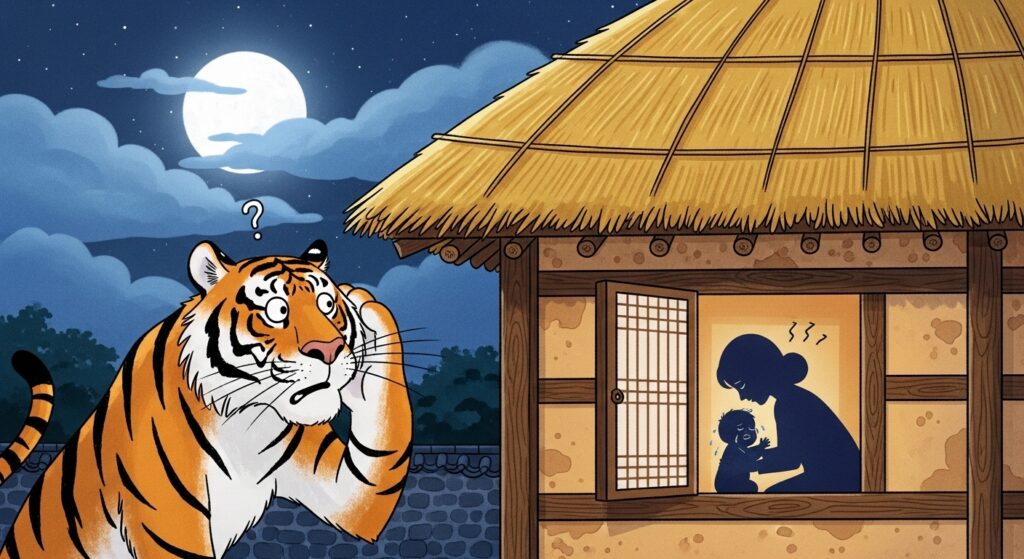
One cold winter night, a fierce predator prowls near a small mountain house, looking for prey. His stomach growls, and he’s ready for a good meal. Inside the house, a baby cries loudly – wailing at the top of its lungs, disturbing the peaceful night.
The mother, exhausted and desperate after hours of trying to soothe her child, attempts everything she can think of. She rocks the baby, hums lullabies, walks around the room – nothing works.
Starting Small
Finally, she tries using fear. “Don’t cry!” she warns in her sternest voice. “The wolf will get you!”
Outside, our predator perks up his ears. “Wolf?” he thinks dismissively. “Please. Wolves are nothing. The child should be more worried about ME!” He waits confidently, expecting the mother to mention him next.
But the baby keeps crying. The wolf threat means nothing to this child.
The Predator’s Moment
The mother, getting more desperate, escalates. “Be quiet! The TIGER is coming!”
NOW he sits up straighter, feeling quite pleased with himself. “Ah, there we go!” he thinks. “Finally, they’re warning the child about the REAL danger. About ME, the mighty hunter! My reputation precedes me. I must be truly fearsome!”
His pride swells. Here he is, mentioned as more frightening than wolves! He feels rather magnificent. Surely THIS will stop the child’s crying.
But the baby keeps crying. In fact, the baby cries even LOUDER!
The Shock
He’s genuinely shocked. “What?! The child isn’t even afraid of ME? The king of these mountains? This is… this is outrageous!”
He’s quite offended now, his pride deeply wounded. But he’s also curious. If neither wolves nor tigers can frighten this child, what possibly could? He decides to wait and see.
The Mystery of Gotgam
Then the mother, at her absolute wit’s end, desperate for sleep, says something different: “If you stop crying right now, I’ll give you a dried persimmon (gotgam).”
And then – miracle of miracles – the baby stops crying. Just like that. Instantly. Complete silence.

Our protagonist is absolutely terrified. His eyes widen in fear. His jaw drops. “What in the world is this ‘gotgam’?!” he thinks, now genuinely frightened. “It must be the most fearsome creature imaginable! More terrifying than wolves! More powerful than me!”
He reasons it through in growing panic: “The baby wasn’t afraid of wolves – those are clearly weak. The baby wasn’t afraid of ME, the mighty hunter – apparently I’m nothing compared to this gotgam! But the moment this mysterious monster gets mentioned – instant silence! The child must be paralyzed with fear! This gotgam must be the supreme predator, the most dangerous beast in existence! I need to get out of here before this gotgam shows up!”
The Thief’s Entrance
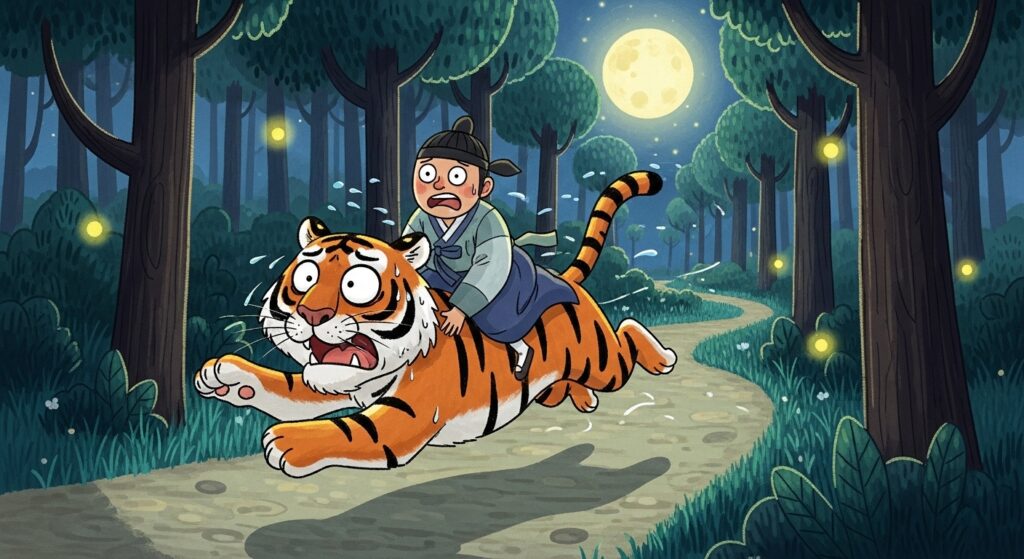
Now thoroughly spooked and ready to flee, he’s about to run when suddenly – THUMP! – something heavy lands directly on his back!
It’s a thief! The thief had been sneaking around, planning to steal from the house. He climbed onto the roof, but the tiles were icy and slippery. He lost his footing and fell, desperately grabbing onto what he thought was a cow or horse tied up outside in the darkness.
The Gotgam Has Caught Me!
Our protagonist, already convinced that the terrifying “gotgam” – the creature more fearsome than himself – is nearby, feels something grab his back and jumps to the only logical conclusion: “OH NO! THE GOTGAM HAS CAUGHT ME! THE SUPREME PREDATOR IS ATTACKING!”
In absolute panic – the kind of fear he’s never felt before in his entire life – he runs. He runs faster than he’s ever run, tearing through the forest with the thief clinging desperately to his back, bouncing and sliding with every leap.
The thief, meanwhile, feels equally terrified but for different reasons. In the darkness, he thought he grabbed a cow to help him escape. But as they race through the forest, he starts to realize this animal is moving WAY too fast and powerfully to be a cow. “What have I grabbed onto?!” he thinks in growing horror.
The Dawn of Truth
He runs and runs, convinced he’s being chased or captured by the mysterious and terrifying gotgam monster – the beast so fearsome that even mentioning its name stops babies from crying, the creature that wolves and tigers fear!
The thief holds on for dear life, too scared to let go.
Finally, as dawn breaks and light filters through the trees, the thief looks down. He realizes – to his absolute horror – that he’s not riding a cow or a horse. He’s riding a TIGER. The most dangerous predator in the forest!
He screams in terror and immediately jumps off, running for his life in one direction.
Hearing the scream, our protagonist becomes convinced the gotgam is making its attack sound. He runs even FASTER in the opposite direction, not daring to look back.
The Legend Spreads
He eventually reaches his fellow tigers in a different part of the mountain, panting and trembling. “I barely escaped!” he gasps to the others. “I encountered the most fearsome creature imaginable – the gotgam! It’s more terrifying than wolves, more powerful than us! It grabbed me and wouldn’t let go! I’m lucky to be alive!”
The other tigers, having never heard of such a creature, feel amazed and frightened. “More powerful than US?” they ask in disbelief. “Tell us more about this gotgam!”
And from that day on, these mountain dwellers lived in fear of something called “gotgam” – never knowing it was just a dried fruit used to stop babies from crying, something that ranked below wolves and tigers in actual danger, but somehow worked when nothing else could!
Why This Tale Is Perfect Korean Humor
This account has remained popular for centuries because it captures so much about our storytelling and humor:
The Mighty Brought Low
There’s something deeply satisfying in our culture about seeing the powerful reduced to foolishness. The ultimate symbol of power and fear becomes a complete fool, terrified of a snack. Our humor often involves deflating pomposity and showing that even the mighty can be ridiculous.
The Comedy of Misunderstanding
Notice how the entire narrative builds on a chain of misunderstandings. He misinterprets the mother’s words. The thief misunderstands what he’s grabbed. Both end up terrified of things that aren’t actually dangerous. This type of comedy appears throughout our folklore – we love accounts where nobody quite knows what’s going on!
Food as Ultimate Comfort
In our culture, food is love, comfort, and the solution to almost every problem. Of course a dried persimmon would be what finally soothes the crying baby! The mother tried fear (tigers, wolves) but what actually worked? Food. This is quintessentially Korean – we believe food can solve most problems.
Relatable Reality
The narrative starts with something every parent knows – a baby crying in the middle of the night and a desperate parent trying anything to make it stop. This everyday reality makes the supernatural elements (the predator’s thoughts, the whole crazy situation) even funnier because it’s grounded in something universally relatable.
No Moral Heavy-Handedness
Unlike fables that beat you over the head with their moral lessons, this account is just… funny. Yes, there’s a lesson about assumptions and fear, but mainly it’s just a great tale that makes people laugh. That’s very Korean too – we like our wisdom served with humor.
My Grandmother’s Performance
My grandmother used to tell me this tale when I was young, and she was a master performer. She’d make her voice deep and proud when the predator was feeling important: “I am the MIGHTY ONE!” Then she’d make it squeaky and terrified: “곶감이 뭐길래?!” (“What IS this gotgam?!”)
She’d act out the running, making exaggerated motions while sitting cross-legged. She’d show the thief’s confusion, the mother’s exhaustion, the baby’s sudden silence. It was a full performance, and I’d laugh until my sides hurt.
I remember one winter evening particularly well. Snow was falling outside, and our whole extended family had gathered. My grandmother performed the gotgam tale, and even the adults were crying with laughter. My uncle kept interrupting, saying “Tell the part about the thief again!” and she’d go back and do it with even more drama.
That’s when I understood: these tales aren’t just stories. They’re performances, experiences, moments of connection. They’re alive.
Even now, when Koreans want to joke about someone being irrationally afraid of something harmless, they might reference this account. “You’re like the tiger and the gotgam!” means you’re afraid of something that can’t actually hurt you.
The Tiger Who Repaid a Kindness: Korean Folktales of Loyalty
Now let’s shift from comedy to something more touching. Not all our tales portray these animals as foolish. Some of the most moving accounts feature them displaying gratitude and honor that puts humans to shame.
The Basic Tale
The most common version goes like this:
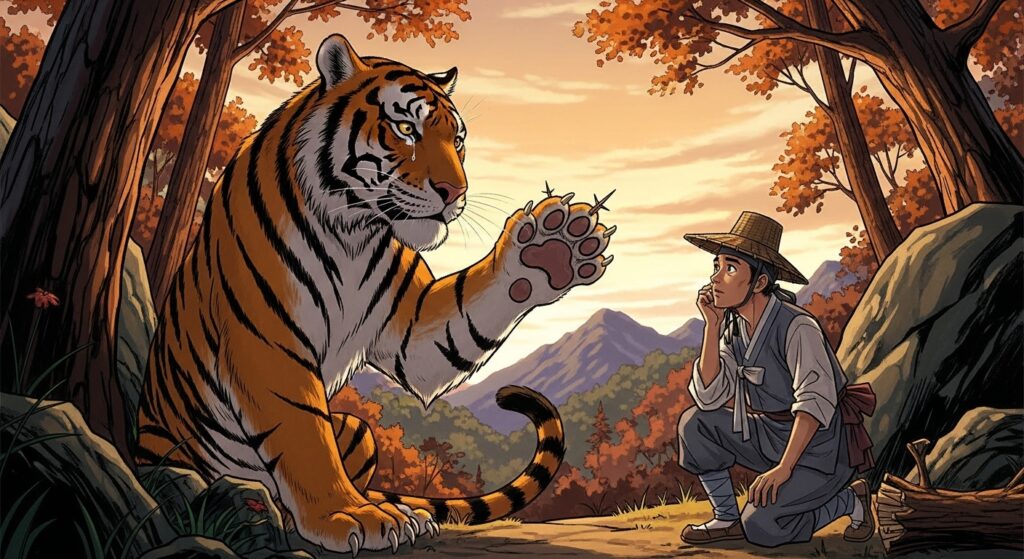
A man travels through the mountains when he encounters one in obvious pain. Instead of running (which would be smart), or attacking him (which the man expects), the animal does something surprising – it shows the man its paw.
There’s a large thorn or bone deeply embedded in the paw, causing terrible suffering. It looks at the man with what seems like… a plea for help?
Most people would run away. But this man – whether out of compassion, curiosity, or bravery – decides to help. He carefully approaches, and it remains still despite its pain. Gently, he removes the thorn from its paw.
It doesn’t eat him. Instead, it looks at him with what seems like gratitude, and then slowly walks away into the forest.
It Remembers
The man thinks nothing more of it. It was a strange encounter, something to tell his children about, but his life goes on.
Months or even years later, the man falls on hard times. Maybe his crops fail, maybe there’s a famine, maybe he faces some other hardship. He struggles to feed his family.
One morning, he finds fresh game left outside his door – a deer or wild boar, clearly recently hunted. This keeps happening. Food appears mysteriously, keeping his family alive through the difficult time.
Then one day, he sees it watching from the edge of the forest. It bows its head slightly, and the man understands: the animal has been repaying his kindness all along.
The Woodcutter Becomes a Son-in-Law
But the tale doesn’t end there. In the complete version from our folklore, something even more remarkable happens.
The man is a poor woodcutter, living with only his elderly mother. One night, the grateful creature returns – but this time, it carries a beautiful young woman on its back! The woman has fainted from fear, but she’s unharmed.
When she awakens, they discover she’s the precious daughter of a high magistrate from a neighboring village. The creature had brought her to the woodcutter’s home.
The woodcutter, horrified that the animal might have caused trouble despite its good intentions, takes excellent care of the magistrate’s daughter and returns her safely to her family.
The magistrate, deeply impressed by the woodcutter’s kindness and integrity, decides to make him his son-in-law. The woodcutter marries the magistrate’s daughter and gains wealth and status – all thanks to the grateful creature who never forgot his kindness.
The Final Act of Gratitude
Years pass. The woodcutter lives happily as the magistrate’s son-in-law. But he never forgets the animal that changed his life.
One day, terrible news spreads through the village: a dangerous creature has been terrorizing the area. The king has offered a huge reward and a high position to anyone who can capture it.
That night, the woodcutter hears a familiar sound outside his door. It’s the same animal – now old and weary.
The creature speaks in a low voice: “Master, thanks to your kindness, I lived a long life. But now I’m old and weak. If I continue like this, I’ll eventually be captured and killed by others. Rather than dying at a stranger’s hands, I want to repay your kindness one final time. Please shoot me, and claim the reward and position. This is my last gift to you.”
The woodcutter is shocked. “No! You’ve shown me such great kindness! How could I possibly kill you?”
But the creature insists: “Please, this is what I wish. Let me repay your grace one final time.”
The Tragic Farewell
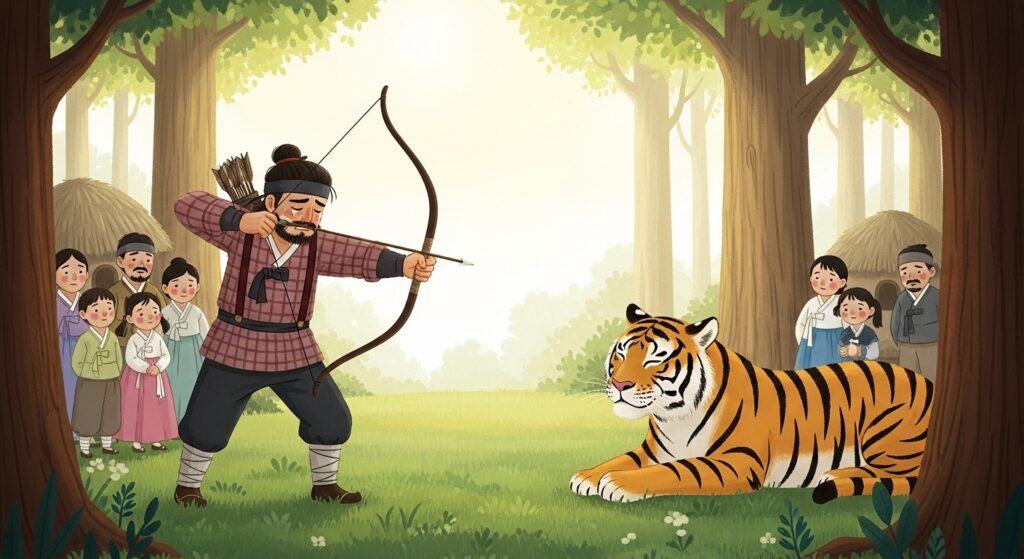
The woodcutter, torn by grief but unable to refuse the creature’s earnest plea, takes up his bow the next morning. In front of the gathered villagers, he aims at the animal.
Unable to shoot directly at his benefactor, the woodcutter deliberately aims to miss. But the creature, having already made up its mind, actually runs toward the arrow, ensuring it strikes true.
The crowd cheers: “The tiger is captured!”
But the woodcutter weeps as he watches the animal that gave him everything fall. As promised, he receives the enormous reward and a high government position.
However, he never forgets. In a secret sunny spot where no one knows, he buries the creature with utmost care and respect. For the rest of his life, he lives honorably, always remembering the final act of grace from the animal that valued loyalty above life itself.
The Trial Version
In another version, the tale takes a more dramatic turn:
The man who helped gets falsely accused of a crime later (the details vary – sometimes theft, sometimes even murder). The punishment is death – authorities will throw him to tigers as execution.
When they throw him into the pit in front of a crowd, everyone expects to see him torn apart immediately. But one approaches – the very one he once helped. Instead of attacking, it recognizes him.
It stands guard over the man, gently pushing away other animals, refusing to let any harm come to him. This miraculous display proves the man’s innocence – if even these fierce predators recognize his goodness and won’t harm him, surely he must be virtuous!
What These Tales Teach
The grateful animal accounts served important functions in our culture:
Eunhye – The Obligation of Gratitude
In our culture, we have a concept called “은혜” (eunhye) – a grace or kindness that creates an obligation to reciprocate. It’s deeper than just saying “thank you.” When someone shows you significant kindness, you carry an eunhye obligation to remember and repay it when possible.
These tales dramatize this concept beautifully. If a wild, fierce predator can understand and honor eunhye, how much more should humans do so?
Kindness Transcends Everything
The accounts teach that kindness should cross all boundaries – even between species, even between predator and potential prey. Compassion is universal and will be recognized and rewarded, no matter how unlikely that seems.
Actions Over Words
The animal doesn’t thank the man with words (it can’t speak in most versions). It thanks him with actions – protection, provision, loyalty, and ultimately, self-sacrifice. This reflects our cultural value: actions matter more than words. Don’t just say you’re grateful; prove it through what you do.
The Real Animals
There’s also subtle criticism embedded in these tales. When one shows more loyalty and gratitude than many humans do, it makes us question who the real animals are. It acts with pure, honest gratitude, while humans often fail to repay kindness or even betray those who helped them.
Why I Love These Tales
I find the grateful animal accounts particularly touching because they show these creatures as capable of feelings we consider deeply human – gratitude, loyalty, memory, honor. It doesn’t help the man because it expects something in return or because someone’s watching. It helps because it remembers kindness and wants to repay it.
In a way, the animal is more human than many humans. It embodies the best of what we should be: remembering those who helped us, repaying kindness, showing loyalty. It’s a beautiful ideal wrapped in a simple narrative.
My grandfather used to say that these accounts weren’t really about tigers at all – they were about what kind of people we should try to be. “Be like the grateful tiger,” he’d tell me. “Never forget those who helped you when you needed it.”
I carry that lesson with me still. When I face decisions about helping others or repaying kindness, I think of that tale. If a fierce predator could remember and honor kindness, how can I do less?
Tigers in Children’s Lives Today
Even though our children today will never see a wild one, these tales keep them alive in their imagination. Every kid knows the gotgam account. Families tell it at home, schools teach it, and it appears in children’s books and cartoons.
Modern children’s books often feature friendly versions – influenced by both the Hojakdo tradition and these folktales. They might be silly like in the gotgam account, or noble like the grateful one, but they’re always recognizably Korean in character.
When these kids grow up and see a character like Derpy in K-pop Demon Hunters, there’s instant recognition. “Oh, it’s a Korean-style character!” They understand the humor, the personality, the cultural references – all without needing explanation.
This is how culture perpetuates itself. The tales pass from generation to generation, adapting to new forms (from oral accounts to books to webtoons to animated characters) but keeping their essential Korean character.
From Laughter to Wisdom
We’ve now explored two very different types of tales:
“Tiger and Dried Persimmon” teaches us:
– Don’t assume things are more frightening than they are
– Fear often comes from misunderstanding
– Even the mighty can be foolish
– Laughter is important – we don’t have to take everything seriously
“The Tiger Who Repaid a Kindness” teach us:
– Kindness should transcend all boundaries
– Always remember and repay those who helped you
– Actions speak louder than words
– True nobility comes from character, not species or status
– Ultimate loyalty means valuing gratitude above even life itself
Together, these accounts show the range of how Koreans viewed these animals: sometimes as figures of fun, sometimes as moral examples, but always as important characters that had something to teach us.
What’s Coming Next
We’ve laughed at the foolish predator terrified of dried persimmons. We’ve been moved by grateful ones showing honor and loyalty. But there’s one more dimension we haven’t explored yet – the philosophical and critical.
In Part 4, our final installment, we’ll discover “Hojil” – a brilliant 18th-century tale where one becomes one of Korea’s sharpest social critics. We’ll see how this account challenged power and hypocrisy, and why it still resonates today.
We’ll also tie everything together: from Derpy to dried persimmons to deep philosophy, understanding the complete picture of what these animals mean in our culture.
Your Favorite?
Which tale resonated with you more – the hilarious gotgam account or the touching grateful animal tales? Or maybe you liked them equally for different reasons?
Have you noticed similar patterns in other Korean folktales or media you’ve encountered?
For Korean readers: How did your family tell these tales? Did they have their own versions or variations?
These accounts are meant to be shared, retold, and enjoyed together. That’s how they’ve survived for centuries – through people like us, passing them on with laughter and love.
Related Questions You Might Have
- [Korean Tiger Symbolism: The Complete Guide] — Start here for the full picture of how tigers became Korea’s most iconic symbol
- Korean Tiger Wisdom: When Tigers Became Philosophers — How Joseon-era folk tales turned the tiger into an unlikely teacher
- Why Koreans Laughed at Tigers: Korean Tiger Symbolism From Past to Present — From minhwa folk paintings to modern culture, why the laughing tiger endures
- Korean Tiger Symbolism: Why Derpy Became the K-pop Demon Hunters’ Tiger — How the ancient laughing tiger found a new home in K-pop animation
Shared by Oldtree of Mindgrove
Stories of Korea © 2025
Comments
One response
[…] to the final chapter of our journey through Korean tiger culture! We’ve laughed at the dried persimmon story and met grateful tigers who repaid kindness. Now we explore the deepest layer: “Korean tiger wisdom” embedded in stories that […]