From Humor to Truth
Welcome to the final chapter of our journey through Korean tiger culture! We’ve laughed at the dried persimmon story and met grateful tigers who repaid kindness. Now we explore the deepest layer: “Korean tiger wisdom” embedded in stories that critique society and question what it means to be human.
This is where Korean folktales reveal their true brilliance. And it connects directly to why characters like Derpy resonate so deeply with audiences today.
“Hojil”: The Tiger Who Spoke Truth
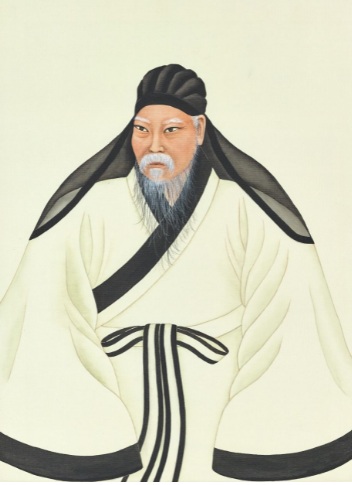
In 1779, scholar Park Jiwon wrote “Hojil” – “The Tiger’s Rebuke.” This brilliant satire represents “Korean tiger wisdom” at its sharpest: using animal voices to critique power when human voices would face execution. The story unfolds like a dark comedy, building from humor to devastating social criticism.
The Tiger’s Court:
The story begins with a tiger consulting his “changgwi” – the ghosts of people he’s eaten, who now serve him. In Korean folklore, victims of tiger attacks became ghostly servants bound to their killer. These ghosts recommend various humans – doctors, shamans, scholars – but the tiger rejects them all as inedible, finding fault with each profession.
However, one ghost has a recommendation: “Master Bukgwak, the great scholar who has written and translated 15,000 volumes before age forty. Surely such a learned man must be delicious!”
The Scandal:
The tiger descends to the village where Master Bukgwak lives. This village also has Lady Dongni, a widow so virtuous that the emperor himself honored her chastity with a title and land grant.
But here’s the delicious irony Park Jiwon creates: Lady Dongni’s five sons each have different surnames – meaning different fathers. And tonight, Master Bukgwak is secretly meeting this “virtuous” widow.
When her sons discover them together, they don’t blame their mother. Instead, they assume: “Master Bukgwak would never do such a thing! This must be a fox spirit in disguise! Let’s skin it and sell the fur, then divide the meat!”
The Dung Pit:
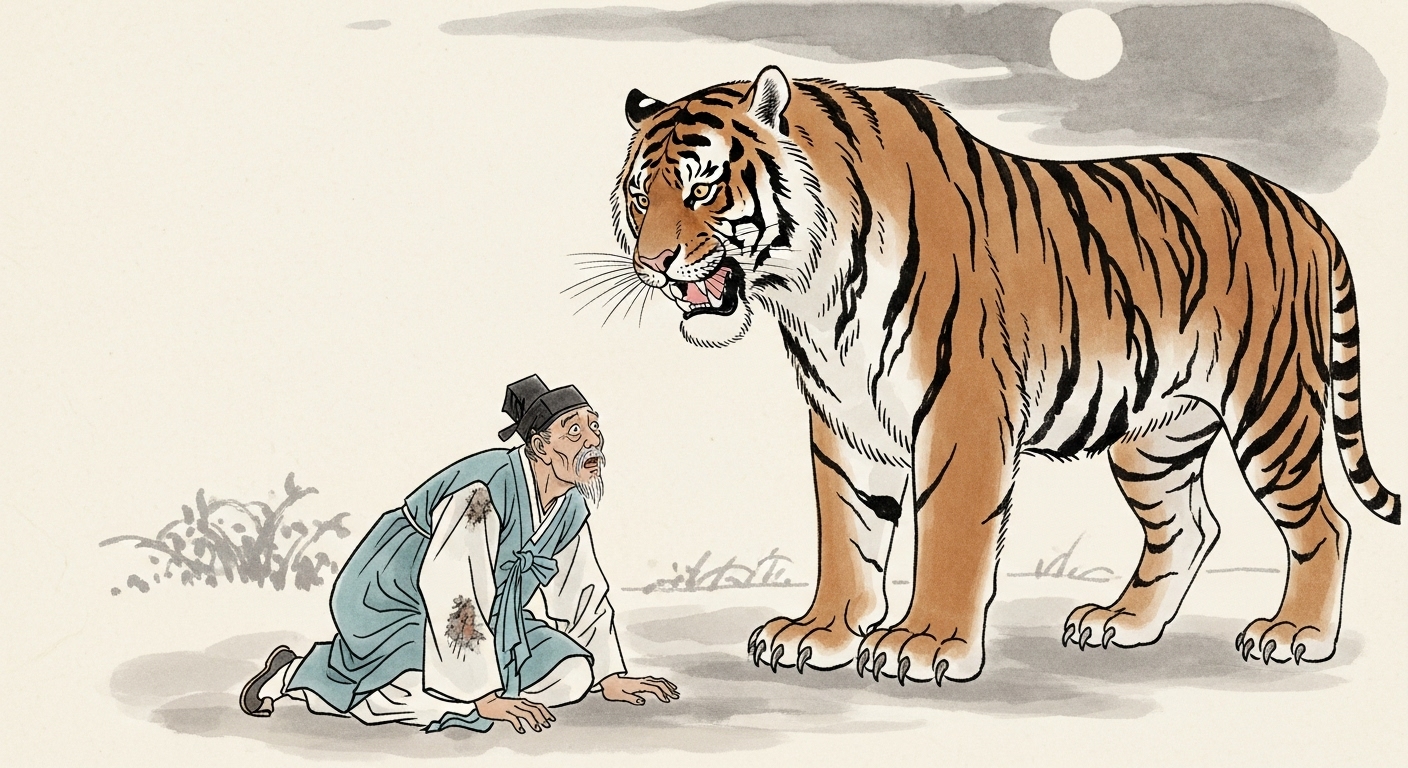
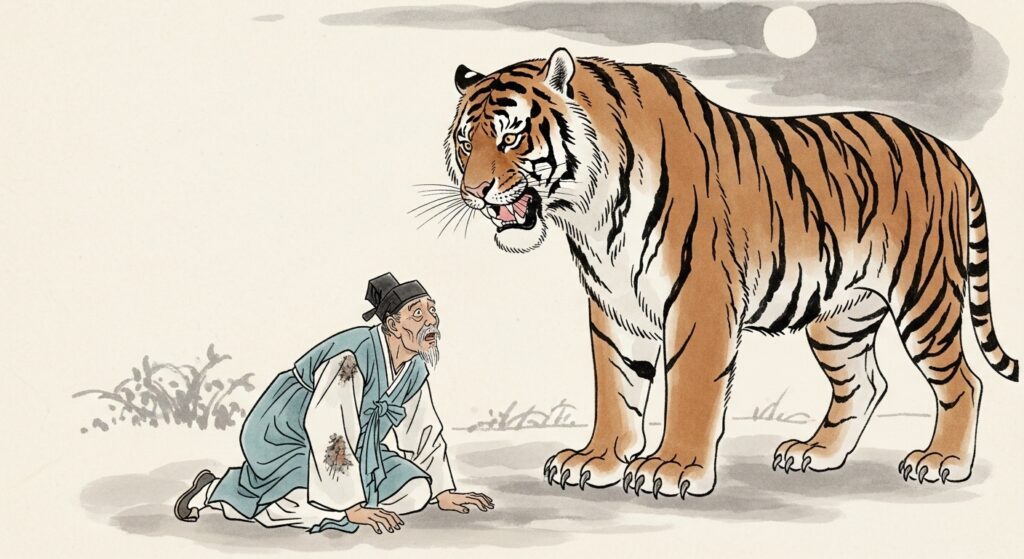
Terrified, Master Bukgwak flees. In his panic, he falls into a dung pit (outdoor toilet). He scrambles out, covered in filth, and runs desperately through the fields – when he encounters the tiger.
The tiger wrinkles its nose and covers its face: “Eo-heo! – Scholar, you stink!”
Master Bukgwak, despite having written and translated 15,000 volumes, immediately abandons all dignity. He grovels: “Oh great King of the Mountain! Magnificent lord! I am your humble servant!”
The tiger’s eyes narrow. “King of the Mountain? Interesting. You scholars usually call me ‘harmful beast’ and ‘mountain bandit.’ Now that you need me, suddenly I’m royalty?”
The Tiger’s Four Devastating Arguments:
What follows is one of the most powerful pieces of social criticism in Korean literature. The tiger delivers four arguments that expose human hypocrisy – this is “Korean tiger wisdom” and “Hojil” at its most brilliant:
First Argument – On Nature:
“You claim human nature is good and tiger nature is evil. But the principle of all things is one. If my nature is evil, then your nature is evil. If your nature is good, then mine is good. We’re not different species – we’re both creatures following our nature. The difference is: I’m honest about mine. You lie about yours.”
Second Argument – On Law:
“We tigers have no laws, no courts, no prisons, no police. Yet we live in order. You humans create elaborate legal systems, endless punishments, torture devices, execution methods. Yet your crimes never stop. Your ‘civilization’ breeds more violence than any wilderness. Who is the real savage?”
Third Argument – On Greed:
“I hunt deer when I’m hungry. I eat what I need. That’s all. But you? You complain when I take one of your livestock, yet you’ve enslaved those animals their entire lives, worked them to exhaustion, then butchered them and used every piece – skin, bones, organs. You don’t just eat – you exploit.
You hunt the very deer I need for survival. You leave not one grain of rice for the grasshopper. You steal silk from silkworms who labor to make their cocoons. You rob honey from bees who worked all summer. Every single thing in nature, you take and take and take. Tell me: who is more cruel and greedy – the tiger who eats when hungry, or the human who exploits everything?”
Fourth Argument – On Kinship:
“I don’t eat leopards because they’re my kin. I cannot bring myself to harm my own kind. But you humans? You harm your own family for money. You betray your brothers for power. You exploit your neighbors, wage war on your cousins, enslave your own species. Between tigers and humans, who is the true beast?”
The Brilliant Ending:
The tiger finishes speaking and walks away without looking back. Master Bukgwak, who was trembling and pressing his filth-covered face to the ground, slowly looks up. The tiger is gone.
Just then, a farmer arrives to plow his field. “Master Bukgwak! What are you doing bowing to the ground so early in the morning?”
Master Bukgwak immediately straightens his robes, composes his face into scholarly dignity, and pronounces grandly: “No matter how high heaven is, one must bow. No matter how thick the earth is, one must tread carefully.”
The farmer, impressed by this profound wisdom, walks away. Master Bukgwak, the great scholar who just fled through a dung pit, who just groveled before a tiger, who embodied every hypocrisy the tiger criticized – pretends nothing happened.
This ending is perfect. Park Jiwon shows us that the tiger’s criticism, no matter how devastating and true, changes nothing. The hypocrite immediately returns to his performance of dignity. The cycle continues.
Why This Story is Genius:
Park Jiwon uses “Korean tiger wisdom” and the “Hojil” framework to create a multi-layered satire. Every element attacks hypocrisy:
– The “virtuous” widow who bore five sons to different men
– The “great scholar” who sneaks around for affairs
– The “learned” man who falls in dung and grovels when scared
– The “civilized” human who proves more savage than any animal
– The “moral” teacher who learns nothing from being taught
The “Hojil” story exemplifies how “Korean tiger wisdom” tradition – using animals to speak dangerous truths – works at the highest literary level.
Why a Tiger for Philosophy?
Park Jiwon chose tigers for specific reasons that exemplify “Korean tiger wisdom”:
Power and Fear: Tigers commanded respect. Their words carried weight because these creatures could literally end your life.
Outside Social Hierarchies: Tigers don’t care about your rank or title. This made them perfect vehicles for truth-telling that would be dangerous from human characters.
Protection from Censorship: Putting radical criticism in a tiger’s mouth created distance. Park Jiwon could say “the tiger said it, not me” – though everyone understood his message.
This tradition of “Korean tiger wisdom” appears throughout Korean literature, where tigers serve as honest critics of society.
External Resource: Explore Korean literary history at the [National Museum of Korea](https://www.museum.go.kr/site/eng/home).
Park Jiwon: The Radical Voice
Park Jiwon belonged to the Silhak movement – “practical learning.” These Joseon Dynasty intellectuals believed in:
– Challenging conventional thinking
– Addressing real social problems
– Questioning rigid class systems
– Criticizing empty ritual and hypocrisy
Direct criticism meant execution. So they used stories. And tigers. And “Korean tiger wisdom” to hide revolutionary ideas in folktales.
“Hojil” launches a devastating attack on the entire social system while disguised as “just a tiger tale.”
Why This Wisdom Still Matters
“Korean tiger wisdom” resonates today because the problems it addresses remain:
Hypocrisy exists. People claim moral authority while behaving badly.
Power corrupts. Officials exploit those they serve.
Appearances deceive. Society values the appearance of virtue over actual virtue.
When you understand this “Korean tiger wisdom” tradition, you see its influence everywhere in modern Korean culture:
– K-dramas where powerful people face truth-tellers
– Webtoons where unlikely characters speak uncomfortable truths
– Films questioning who the real monsters are
The tradition of using tigers to critique power continues in characters like Derpy, who exist outside human social hierarchies.

What Tigers Taught Korea
Looking across all stories in this series, we see what “Korean tiger wisdom” encompassed:
Tigers as Teachers: Whether making us laugh or examine our morality, tigers instructed us in how to live and think.
Tigers as Truth-Tellers: Unlike humans hiding behind social masks, tigers spoke directly and honestly. This honesty made them perfect mirrors for human behavior.
Tigers as Equalizers: They treated nobleman and peasant the same, making them perfect vehicles for stories about justice.
Tigers as Bridges: Existing between civilization and wilderness, past and present, they could comment on both worlds.
From Ancient Tales to Modern Characters
Now we understand why Derpy works so brilliantly. This character embodies multiple layers of “Korean tiger wisdom”:
– The Hojakdo tiger: Humorous and approachable
– The geographic tiger: Connected to Korean identity
– The foolish tiger: Making us laugh
– The grateful tiger: Loyal and protective
– The philosophical tiger: Speaking freely, outside hierarchies
The creators tapped into thousands of years of “Korean tiger wisdom” traditions. When Korean viewers see Derpy, these associations activate simultaneously.
For international viewers, understanding these layers transforms the experience. Derpy isn’t just cute – it’s a continuation of ancient storytelling traditions.

The Tigers That Live On
Wild tigers are gone from South Korea. Yet in another sense, tigers have never been more alive.
Every time a child hears “호랑이 담배 피던 시절에” at bedtime, “Korean tiger wisdom” lives on.
Every time someone uses a tiger expression, the wisdom continues.
Every time a character like Derpy appears, the tradition survives.
Every time someone looks at Korea’s map and sees the tiger shape, the spirit remains.
Tigers exist in Korean cultural memory, language, stories, art, and identity. They’re woven so deeply into what it means to be Korean that they can never truly disappear.
This is the most important kind of survival – living on in stories, symbols, and hearts of people who remember.
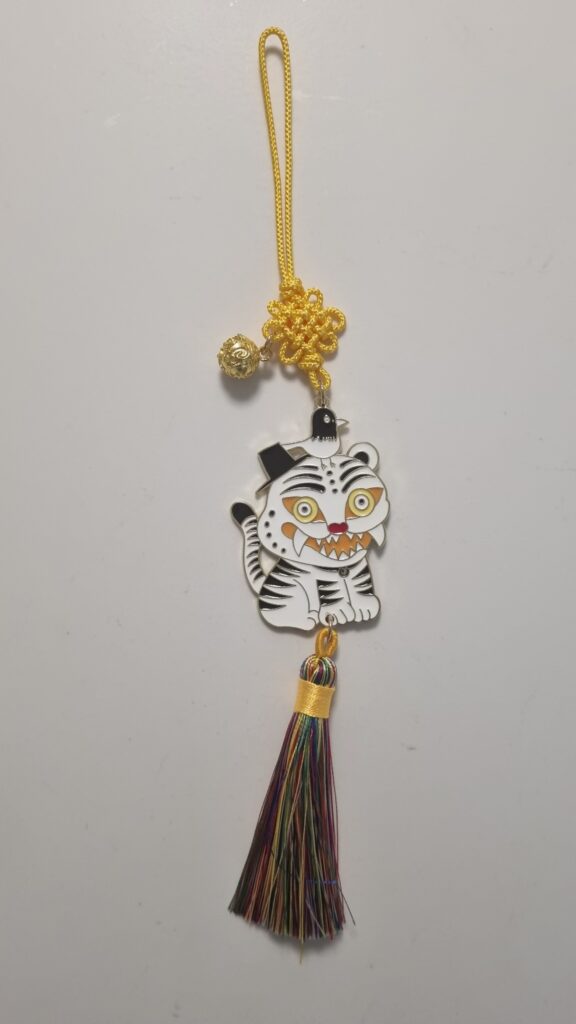
Your Complete Journey
We’ve completed our four-part exploration of Korean tiger culture:
Part 1: We met Derpy and discovered the Hojakdo tradition – tigers as humor and approachability.
Part 3: We laughed at dried persimmon tales and were moved by grateful tigers teaching reciprocity.
Part 4: We discovered “Korean tiger wisdom” in “Hojil” and understood how tigers became vehicles for truth and social criticism.
Together, these parts reveal why Koreans feel such deep connection when they see a tiger. You now understand the cultural layers, historical depth, and emotional resonance.
One Last Question
“Who is the real animal?”
Park Jiwon’s question from 240 years ago still echoes. In a world where appearances deceive and power corrupts, who embodies true virtue?
The “Korean tiger wisdom” tradition continues challenging us through characters like Derpy – clumsy, honest, protective, existing outside human hierarchies – reminding us of timeless truths.
The tigers may be gone from Korean mountains, but their roar echoes through Korean culture, challenging us, teaching us, and reminding us what it means to be truly human.
“감사합니다” (Thank you) for joining this journey through “Korean tiger wisdom”. The tradition lives on – in these stories, and now, in you.
Related Questions You Might Have
- [Korean Tiger Symbolism: The Complete Guide] — Start here for the full picture of how tigers became Korea’s most iconic symbol
- When Tigers Made Korea Laugh: The Dried Persimmon Tale and More — The folk stories where Korea’s mightiest animal keeps getting outsmarted
- Why Koreans Laughed at Tigers: Korean Tiger Symbolism From Past to Present — From minhwa folk paintings to modern culture, why the laughing tiger endures
- Korean Tiger Symbolism: Why Derpy Became the K-pop Demon Hunters’ Tiger — How the ancient laughing tiger found a new home in K-pop animation
Shared by Oldtree of Mindgrove
Stories of Korea © 2025